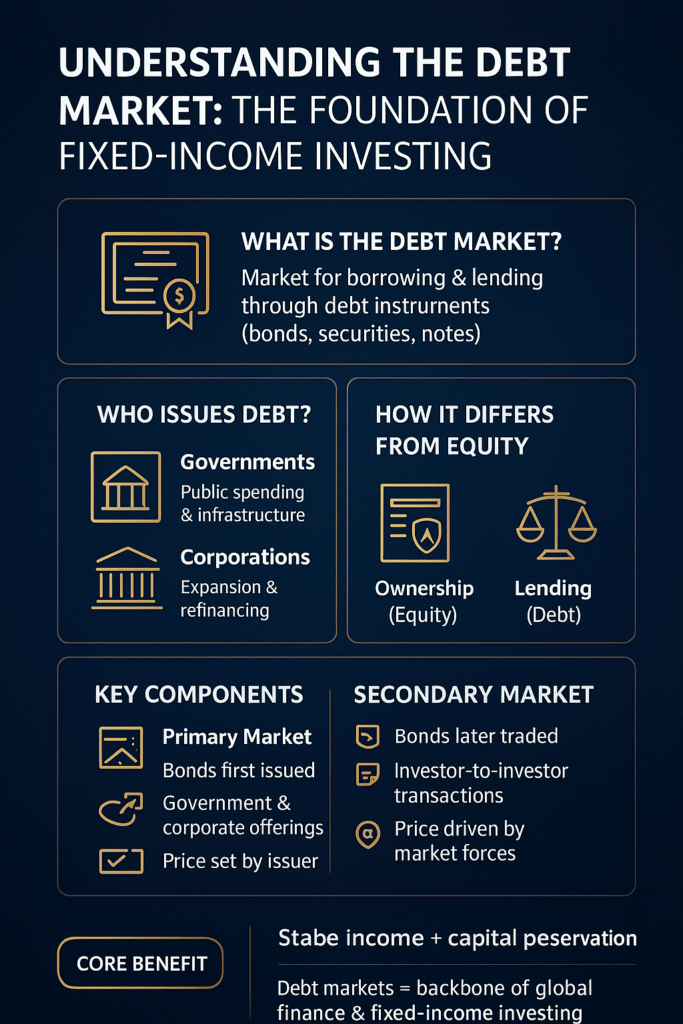
At its core, the debt market—also known as the bond market or fixed-income market—facilitates the borrowing and lending of money through the issuance of debt instruments. Governments issue securities to finance infrastructure and public spending, while corporations issue bonds to fund expansion or refinance existing obligations.
In contrast to the equity market, where investors buy ownership stakes in companies, the debt market involves lending money to issuers in exchange for periodic interest payments and repayment of the principal amount at maturity.
The market is broadly divided into two segments:
- The Primary Debt Market, where new bonds are issued.
- The Secondary Debt Market, where these bonds are later traded among investors.
Each serves a distinct function but together form the backbone of global finance.
What Is the Primary Debt Market?
The primary debt market is the arena where new debt securities are issued for the first time. It’s often compared to an initial public offering (IPO) in the stock market—except instead of equity, investors purchase debt instruments such as corporate bonds, municipal bonds, or government securities.
This market enables issuers to raise capital directly from investors. The proceeds go to the company or government body issuing the debt, making it a vital source of funding for economic growth.
How It Works
Issuers collaborate with investment banks or underwriters to structure the offering, set the coupon rate, and determine the issuance price. Once finalized, the bonds are sold directly to investors through public issues or private placements.
For instance, a government might issue a new series of treasury bonds to finance infrastructure projects, while a corporation could issue corporate bonds to expand operations or refinance existing loans.
Characteristics of the Primary Market
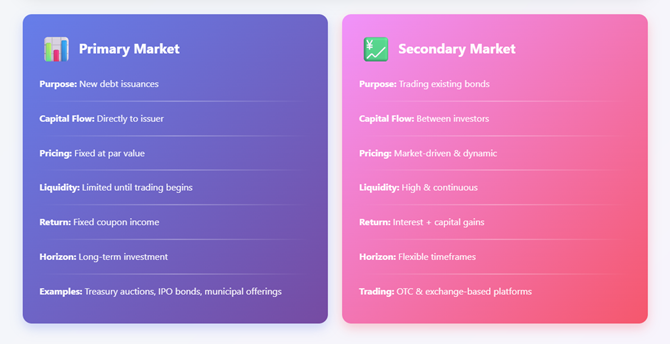
- Direct Capital Transfer: Investors’ funds go straight to the issuer.
- Fixed Pricing: Bonds are generally issued at par value, with a fixed coupon rate.
- Limited Liquidity: Investors typically hold bonds until they start trading on the secondary market.
- Underwriting Role: Investment banks or financial institutions underwrite the issuance, assuming risk if the bonds aren’t fully subscribed.
Examples
- U.S. Treasury auctions for government bonds.
- Corporate bond issuances by major firms like Apple or Toyota.
- Municipal bonds are issued by city governments for public works.
The primary market serves as the first step in a bond’s lifecycle, allowing capital to flow from investors to issuers efficiently.
What Is the Secondary Debt Market?
Once bonds are issued and distributed in the primary market, they enter the secondary debt market. Here, existing debt securities are traded between investors—similar to how shares are traded on stock exchanges after an IPO.
In this market, the issuer no longer receives any proceeds from transactions. Instead, investors buy and sell bonds based on prevailing interest rates, credit conditions, and market demand.
Key Characteristics
- Liquidity: The secondary market provides investors the flexibility to sell before maturity.
- Price Discovery: Bond prices fluctuate based on market conditions, providing real-time valuation.
- Over-the-Counter (OTC) and Exchange-Based Trading: While most bond trading occurs OTC, certain government and corporate bonds are also traded on exchanges.
- Yield and Capital Gains: Investors can profit from both interest payments and changes in bond prices.
Why It Matters
The secondary market ensures continuous liquidity in the bond market. Without it, investors might hesitate to purchase bonds in the primary market, fearing they couldn’t resell them later. In this way, a robust secondary market supports healthy demand in the primary market.
The Interconnection Between the Two Markets
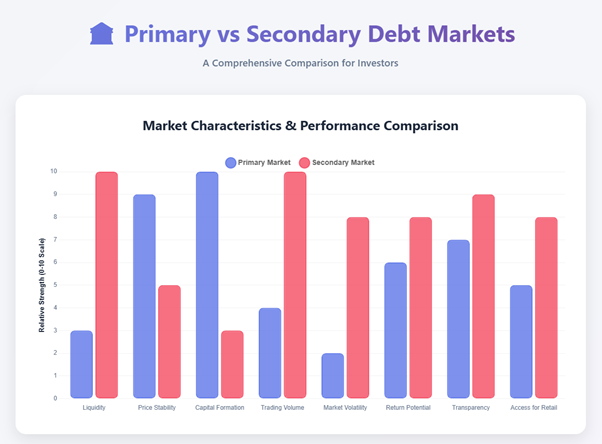
The primary and secondary debt markets are not isolated—they form an interconnected ecosystem. The performance and liquidity of the secondary market directly influence investor confidence in new issuances.
When secondary market activity is strong, investors are more likely to buy new issues, knowing they can easily sell them later if needed. Conversely, if the secondary market is illiquid or volatile, demand for new bonds in the primary market may weaken.
This relationship creates a feedback loop where the secondary market provides liquidity, and the primary market ensures capital formation—both indispensable for a balanced financial system.
Pricing Mechanisms: How Bonds Are Valued
In the Primary Market
Pricing in the primary market is relatively straightforward. The coupon rate and issue price are determined based on the issuer’s creditworthiness, current interest rates, and investor demand. Bonds are typically issued at par value (100%), although discounts or premiums may apply depending on market conditions.
In the Secondary Market
Prices fluctuate daily due to:
- Interest Rate Changes: When rates rise, existing bond prices fall, and vice versa.
- Credit Rating Adjustments: Downgrades can decrease bond value, while upgrades increase it.
- Economic Factors: Inflation expectations and market sentiment affect yield spreads.
For example, if a bond with a 5% coupon rate is issued and interest rates rise to 6%, the bond’s price will drop since investors can now find higher yields elsewhere.
This dynamic pricing allows traders to capitalize on interest rate movements and optimize portfolio returns.
Who Participates in Each Market?
In the primary debt market, participants typically include:
- Governments issuing sovereign bonds.
- Corporations raising capital.
- Institutional Investors such as pension funds and insurance companies.
- Banks and Underwriters facilitating the issuance process.
The secondary market, however, attracts a broader range of participants:
- Institutional investors trading large volumes.
- Hedge funds seeking yield arbitrage opportunities.
- Retail investors purchasing bonds via digital platforms.
- Market makers ensuring liquidity through continuous buy-sell quotes.
With the rise of online trading and fintech platforms, access to both markets has become more democratized, allowing smaller investors to participate in what was once an institutional domain.
Risk and Return Dynamics
Understanding the risk-return profile of each market helps investors build balanced portfolios.
Aspect | Primary Market | Secondary Market |
|---|---|---|
Purpose | Capital formation for issuers | Liquidity and trading for investors |
Risk | Credit risk, interest rate risk | Market volatility, liquidity risk |
Return | Fixed coupon income | Interest income + potential capital gains |
Liquidity | Limited until trading begins | High due to active trading |
Investment Horizon | Typically long-term | Short to medium-term flexibility |
In simple terms, the primary market suits investors seeking predictable returns, while the secondary market attracts those pursuing tactical opportunities through price movements.
Technology and Transparency in Modern Debt Markets
The evolution of financial technology has revolutionized both markets.
In the primary market, electronic book-building platforms and blockchain-based bond issuance have streamlined the process, reducing costs and time-to-market. Issuers can now reach global investors through digital channels, bypassing traditional intermediaries.
In the secondary market, algorithmic trading and AI-driven analytics provide real-time data and improve liquidity. Transparency has increased through automated reporting systems that publish bond prices and trade volumes.
Regulators worldwide—such as the U.S. Securities and Exchange Commission (SEC), European Securities and Markets Authority (ESMA), and Reserve Bank of India (RBI)—are also adopting new frameworks to ensure investor protection and maintain market integrity.
Global Trends Shaping the Debt Market in 2025
The global debt landscape in 2025 reflects major shifts influenced by interest rate cycles, inflation control measures, and geopolitical events.
- Surge in Corporate Issuances: Companies are locking in funding before anticipated rate hikes, driving record primary market volumes.
- Green and Sustainability Bonds: Investors are increasingly prioritizing environmentally responsible investments, boosting the issuance of ESG-linked bonds.
- Digital Trading Expansion: The secondary market is benefiting from real-time settlement technologies, improving speed and efficiency.
- Emerging Market Growth: Nations across Asia, Africa, and the Middle East are strengthening local bond markets to attract foreign capital.
- Yield Curve Flattening: Persistent economic uncertainty has led investors to favor shorter maturities, reshaping pricing dynamics across both markets.
These trends underline the growing sophistication of global debt trading and the expanding role of fixed-income assets in diversified portfolios.
How Investors Can Leverage Both Markets
A well-rounded investment strategy often blends exposure to both primary and secondary markets.
Here’s how investors can make the most of each:
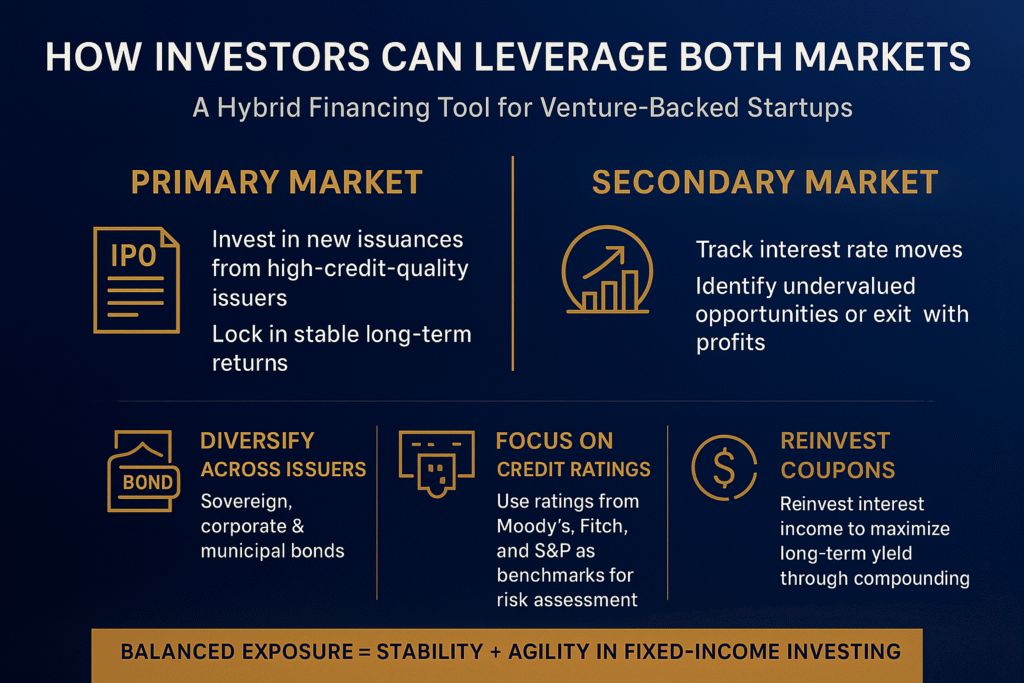
- In the Primary Market: Participate in new issuances from high-credit-quality issuers to lock in stable returns.
- In the Secondary Market: Monitor interest rate changes to identify undervalued opportunities or exit at profit points.
- Diversify Across Issuers: Spread investments across sovereign, corporate, and municipal bonds.
- Focus on Credit Ratings: Use ratings from agencies like Moody’s, Fitch, and S&P as benchmarks for risk assessment.
- Reinvest Coupons: Reinvest interest income to maximize long-term yield through compounding.
Combining both markets helps investors achieve a balance between income stability and market agility.