A practical guide for startup founders on current valuation metrics, investor expectations, and how global funding climates are shifting in 2026.
The investment landscape entering 2026 has transformed more dramatically than at any time since the early 2020s. Funding is still flowing, innovation is strong, yet the rules of venture capital have fundamentally shifted. Storytelling is no longer enough. Investors now demand evidence, financial discipline, and clear monetization from the earliest stages.
Founders aiming to raise capital in 2026 must understand the new valuation benchmarks, the metrics that matter at every stage, and the global economic forces reshaping investor behaviour. Today, resilience, profitability, and operational strength outweigh flashy growth projections. The winners in 2026 know how to scale with precision while demonstrating strong fundamentals.
The New Reality of Startup Funding in 2026
Between 2024 and 2025, the global economy experienced corrections that forced investors to reset expectations. By 2026, these lessons have shaped a more mature investment climate where capital goes to founders who can demonstrate:
- Proven customer demand
- Disciplined cost structures
- Predictable recurring revenue
- A path toward profitability
- Strong internal systems
Founders must now prove operational maturity in much earlier stages, making clarity and financial transparency critical.
What Investors Expect at the Seed Stage in 2026
Seed funding in 2026 is no longer about betting on ideas. Investors expect demonstrated traction—even at small scale—and founders who can move with speed and discipline.
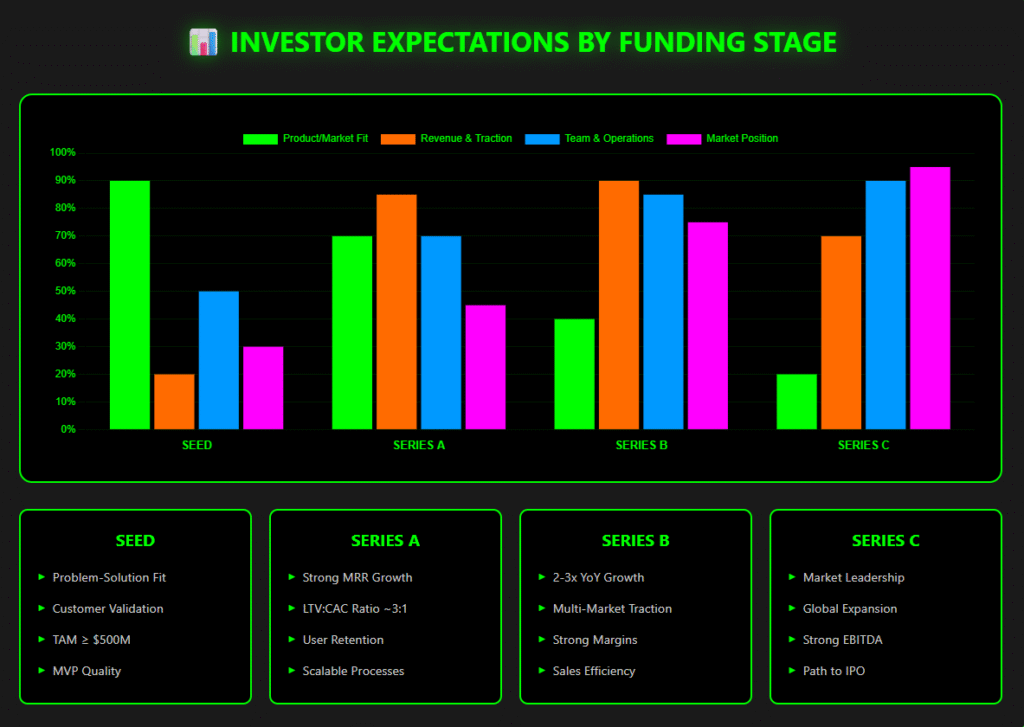
1. Market Validation Over Market Hypotheses
Seed investors want startups that have validated a real problem. They expect:
- Paid pilots or early paying customers
- Clear customer interviews and feedback
- Metrics showing demand beyond assumptions
- A product that solves one high-pain problem exceptionally well
“Pre-revenue” is not a deal-breaker, but pre-validation is.
2. Lean, Capable Founding Teams
Talent density matters more than team size. Seed investors prefer:
- Founders with domain expertise
- Ability to build without heavy outsourcing
- Clear division of roles and ownership
- A track record (even small one) of execution
A lean, focused team signals efficiency and founder-led resilience.
3. A Sharp MVP With Immediate Value Delivery
Investors in 2026 avoid feature-stacked early products. They prioritize:
- Fast onboarding
- Clear value within days, not months
- Strong early retention metrics
- Evidence that customers understand and need the product
The MVP must solve one pain point better than any existing solution.
Seed-Stage Valuation Metrics (2026)
Common benchmarks include:
- $500K–$1.5M ARR for stronger Seed rounds
- Churn under 8–10% (monthly) for SaaS MVPs
- CAC recovery under 12 months
- 10–20 paying customers for B2B products
- 3x–5x YoY growth potential
Seed valuations are tied to traction quality, not just TAM size.
What Investors Expect at Series A in 2026
Series A has become the “scalability proof round.” Investors only deploy capital once a startup shows repeatable revenue generation.
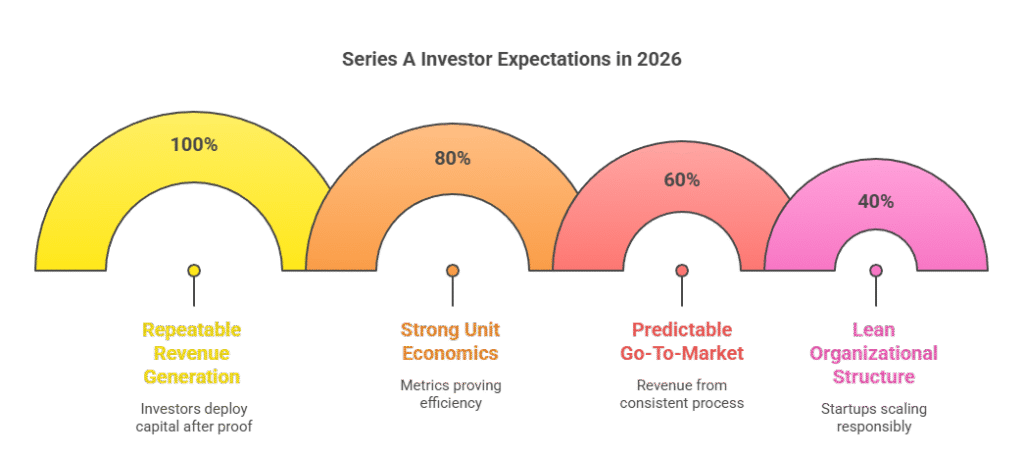
1. Strong Unit Economics
Investors insist on metrics that prove efficiency:
- LTV:CAC ratio of 3:1 or higher
- Gross margins 65–80%
- CAC payback < 10 months
- Monthly churn < 3% (SaaS)
Investors must be convinced that every dollar invested returns multiples.
2. Predictable Go-To-Market (GTM) Motions
Founders must prove that revenue comes from a consistent process, not founder hustle. Investors look for:
- Documented sales playbooks
- Strong inbound channels
- Repeatable outbound strategies
- Clear analytics on funnel conversion
GTM consistency directly influences valuation multiples at Series A.
3. Lean But Effective Organizational Structure
Teams must be built for scale—not bloated headcount. Investors expect:
- Clear hiring plans tied to revenue milestones
- Strong leadership at product, engineering, and GTM
- Clean financial operations
- Cash burn aligned with revenue trajectory
Series A investors favour startups that scale responsibly.
Series A Valuation Metrics (2026)
Typical benchmarks:
- $2–$5M ARR
- 5–8x ARR valuation multiples
- NRR of 110–130%
- 6–10 months cash runway pre-funding
- Clear, validated GTM engine
Series A is commitment capital, not experimentation capital.
What Investors Expect at Series B in 2026
Series B is about proving market leadership and structural scalability.
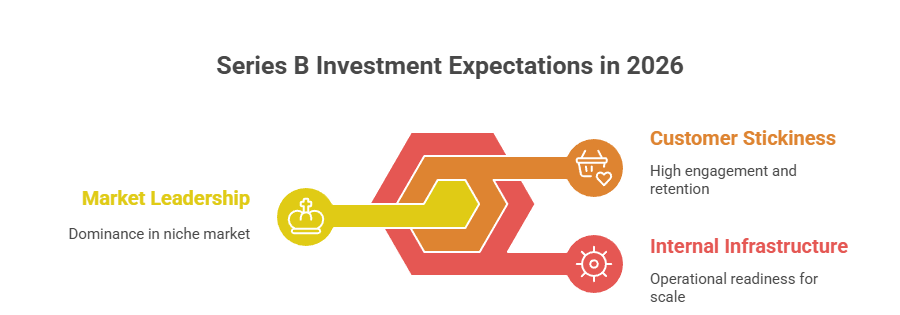
1. Emerging Category Leadership
Investors want startups that dominate their niche. Indicators include:
- Rapidly increasing market share
- High inbound customer interest
- Clear competitive differentiation
- Compounding growth from existing customers
Being “one of many” won’t pass Series B filters.
2. Deep Customer Stickiness
Revenue quality is prioritized over revenue volume. Investors evaluate:
- Usage frequency and engagement
- Expansion revenue
- Customer profitability
- Churn causes and recovery strategies
Startups must show that customers cannot operate without the product.
3. Strong Internal Infrastructure
Investors want companies ready for rapid scale:
- Automated operational workflows
- Mature revenue operations (RevOps)
- Accurate forecasting across departments
- A leadership team capable of managing scale
Series B demands operational excellence, not potential.
Series B Valuation Metrics (2026)
Current expectations:
- $10–$20M ARR
- 8–12x ARR valuation multiples
- NRR of 130%+
- Multiple strong GTM channels
- International expansion readiness
Series B capital now goes to companies preparing for large-scale breakout.
What Investors Expect at Series C in 2026
Series C is reserved for category leaders with global scale potential.
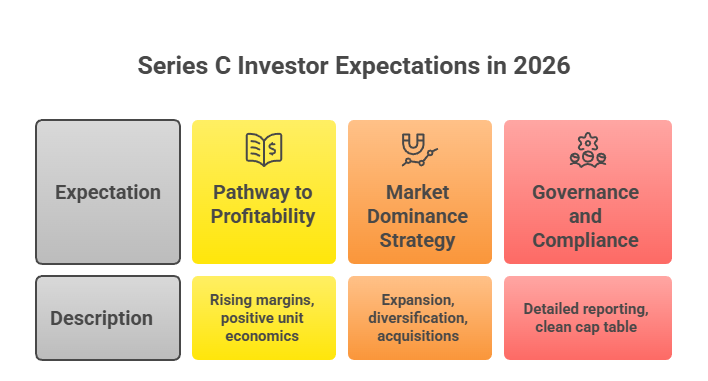
1. Clear Pathway to Profitability
Investors expect:
- Rising contribution margins
- Predictable positive unit economics
- Clear profitability timeline
- Efficient cost structure across markets
Hypergrowth without profitability signals is no longer tolerated.
2. Market Dominance Strategy
Series C funding fuels:
- Expansion into new geographies
- Product diversification
- Strategic acquisitions
- Ecosystem building
Investors want companies that are becoming the default choice in their industries.
3. Advanced Governance and Compliance Maturity
Series C investors expect near-public-company standards:
- Detailed financial reporting
- Clean cap table
- Real-time compliance processes
- Structured risk management
Governance strength influences valuation heavily at this stage.
Series C Valuation Metrics (2026)
Benchmarks include:
- $30–$60M ARR
- 10–14x ARR multiples
- NRR 130–150%
- Active multi-region operations
- Path to profitability within 18–24 months
Series C investors are backing future IPO candidates, global category leaders, or acquisition targets.
Global Funding Climate Post-2026: Regional Breakdown
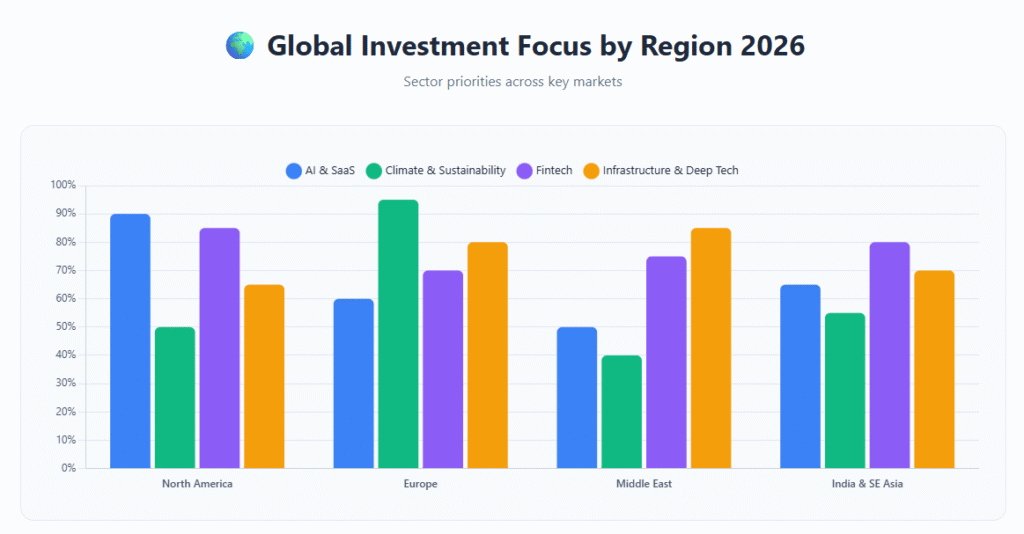
The global funding environment after 2026 shows strong regional divergence. Each market has developed its own investment patterns and expectations.
North America
North America remains the global capital engine, dominated by AI, automation, cybersecurity, deep tech, and fintech. Investors are highly selective and demand:
- Capital-efficient business models
- Rapid ARR growth
- Mature unit economics
- Strong governance and transparency
Valuations have stabilized, but only for startups with genuine moats and measurable traction.
Europe
Europe emphasizes compliance, sustainability, and long-term stability. Investors prefer:
- ESG-aligned business models
- GDPR-compliant data solutions
- Conservative burn rates
- Recurring revenue models with predictable growth
Funding cycles are slower but deeper, especially in AI, climate-tech, and regulated fintech.
Middle East
The Middle East—especially the UAE and Saudi Arabia—is one of the fastest-growing startup hubs post-2026. Investors prioritize:
- AI, logistics, healthtech, and energy transition
- Scalable business models across GCC states
- Startups with efficient operations and global aspirations
Government-backed funding accelerates larger Series A and B checks.
India
India’s funding climate is driven by massive digital adoption and strong revenue-first expectations. Investors focus on:
- Profitability
- Affordable customer acquisition
- Strong monetization models
- SaaS, fintech, mobility, and consumer tech
India attracts both domestic and international capital due to its fast-growing middle class.
Southeast Asia
Southeast Asia continues to scale rapidly, especially in fintech, logistics, and e-commerce enablers. Investors emphasize:
- Cross-border scalability
- Low-cost user acquisition
- Strong mobile-first adoption
- Fast GTM execution
Singapore remains the regional investment hub, while Indonesia leads in consumer-tech scale.
How Founders Can Win Funding Rounds in 2026
Success from Seed to Series C requires founders to master three principles:
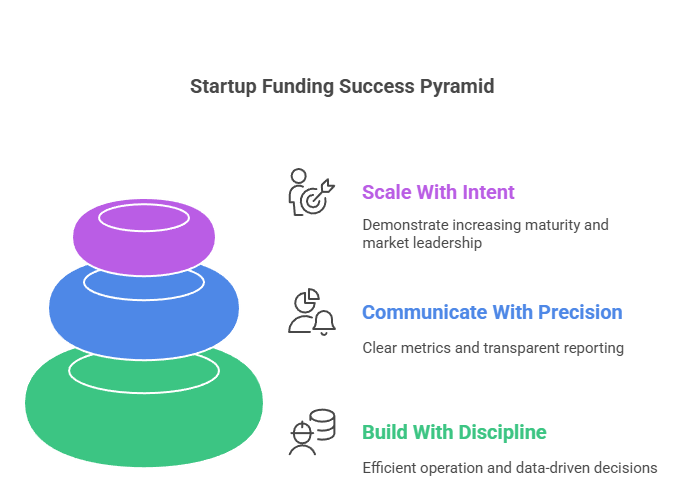
1. Build With Discipline
Efficient operation, validated demand, and data-driven decisions attract serious investors.
2. Communicate With Precision
Clear metrics, transparent reporting, and honest storytelling build investor trust.
3. Scale With Intent
Each round must demonstrate increasing maturity, stronger economics, and market leadership momentum.
Founders who embrace these expectations will raise capital more confidently and position their startups for long-term success in the new global funding era.