
In today’s fast-paced startup ecosystem, access to capital can make or break a business. While equity financing has long been the go-to route for founders, venture debt is rapidly emerging as a powerful alternative. The global funding landscape is evolving, with venture capital firms becoming more selective and startups seeking creative ways to extend their runway without heavy dilution.
Venture debt—often misunderstood as a risky move—is, in fact, a strategic tool when used wisely. It offers startups the ability to scale operations, invest in growth, and reach key milestones before the next equity round. But as with all financial instruments, it’s not a one-size-fits-all solution.
1. Understanding Venture Debt
Venture debt is a form of non-dilutive financing designed for startups already backed by venture capital. Unlike traditional bank loans that require strong cash flows or physical collateral, venture debt lenders rely on the company’s growth potential and VC backing.
These loans typically come with shorter repayment periods (two to four years), interest payments, and warrants—options allowing lenders to purchase equity at a later date. In essence, venture debt gives startups cash now while minimizing ownership dilution.
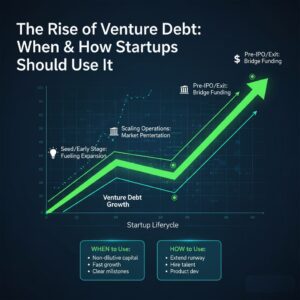
Why It’s Gaining Popularity Among Startups
With venture capital markets tightening and investors pushing for profitability, many startups are turning to venture debt to extend their runway. In 2023 alone, venture debt deals grew over 20% in markets like the U.S. and India, according to PitchBook data.
Startups like Airbnb, DoorDash, and Revolut have used venture debt strategically to weather downturns or accelerate growth without giving away more equity. It’s not just a backup plan—it’s becoming a core part of modern startup financing strategies.
2. What Is Venture Debt?
2.1 Definition and Core Concept
At its core, venture debt is a form of debt financing available to startups that have already raised equity from venture capital firms. The key idea is to complement, not replace, equity. The funds are often used for working capital, product expansion, acquisitions, or extending the runway before the next funding round.
Unlike bank loans that rely heavily on collateral and steady revenue, venture debt lenders base their decision on the startup’s growth trajectory and the reputation of existing investors.
2.2 How Venture Debt Differs from Traditional Bank Loans
The major difference lies in the risk tolerance and evaluation criteria. Traditional banks are conservative—they prefer predictable cash flow and tangible assets. Startups, by nature, have neither.
Venture debt lenders, on the other hand, are comfortable with higher risk. They understand that a startup’s value lies in intellectual property, technology, and market potential, not in hard assets. Hence, they align repayment schedules and terms to the startup’s growth path.
Moreover, banks rarely accept equity warrants, but venture debt lenders often include warrant coverage—a way to participate in future upside without holding ownership immediately.
3. Venture Debt vs. Pure Equity Financing
3.1 Key Differences Between Venture Debt and Equity
Equity financing involves selling ownership stakes in exchange for capital. It’s dilution-heavy but repayment-free. Venture debt, conversely, is repayable capital with minimal dilution.
A simplified comparison:
Aspect | Venture Debt | Equity Financing |
Ownership Dilution | Low | High |
Repayment Required | Yes | No |
Cost of Capital | Lower (Interest + Warrants) | Higher (Equity Loss) |
Speed of Access | Faster | Slower |
Risk Level | Moderate | Depends on market conditions |
3.2 The Impact on Ownership and Control
Equity financing often gives investors a seat at the table—sometimes even control over key decisions. Venture debt doesn’t. Founders retain control while accessing growth capital, making it an appealing option for entrepreneurs who want to maintain strategic independence.
However, the trade-off is the repayment obligation, which can strain cash flow if the company is not growing fast enough.
3.3 Balancing Debt and Equity in Startup Capital Structure
The smartest founders strike a balance between debt and equity. Too much debt increases financial pressure, but over-reliance on equity leads to ownership erosion. An optimal capital structure blends both, using venture debt as a bridge to the next milestone rather than a lifeline.
4. When Should Startups Consider Venture Debt?
4.1 Ideal Scenarios for Using Venture Debt
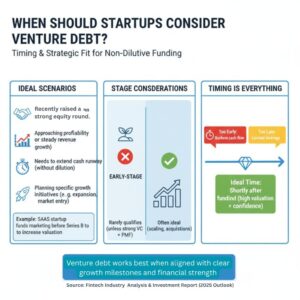
Venture debt works best when a startup:
- Has recently raised a strong equity round
- Is approaching profitability or steady revenue growth
- Needs to extend its cash runway without dilution
- Is planning specific growth initiatives like product expansion or market entry
For instance, a SaaS startup might use venture debt to fund marketing before a Series B round, knowing the growth will increase valuation.
4.2 Early-Stage vs. Growth-Stage Funding Considerations
Early-stage startups rarely qualify for venture debt unless they have strong VC backers and clear product-market fit. Growth-stage startups, however, often find it ideal—especially if they’re scaling or planning acquisitions.
4.3 Timing and Strategic Fit
Timing is everything. Using venture debt too early can burden cash flow, while using it too late may offer limited leverage. The ideal time is shortly after a funding round, when the company’s valuation and investor confidence are high.
5. How Venture Debt Deals Are Structured
5.1 The Anatomy of a Venture Debt Agreement
A typical venture debt deal involves a term loan or credit facility, coupled with interest payments, warrant coverage, and covenants governing financial performance.
Lenders often assess the company’s runway, revenue trajectory, burn rate, and VC syndicate strength before offering terms.
5.2 Term Loans, Revolving Credit, and Equipment Financing
- Term Loans: Fixed sum repaid over time, often 2–4 years.
- Revolving Credit Facilities: Flexible borrowing based on working capital needs.
- Equipment Financing: For hardware-heavy startups (e.g., robotics, biotech).
5.3 Common Structures in Venture Debt Deals
Lenders may combine debt instruments to suit the startup’s needs—for instance, offering a revolving credit line with a small term loan and warrant coverage.
This flexibility allows startups to structure deals that align with cash flow patterns and growth milestones.
6. Interest Rates, Warrants, and Covenants Explained
6.1 Understanding Interest Terms
Interest rates in venture debt deals tend to be higher than traditional bank loans but lower than the implicit cost of equity. Typically, they range between 8% to 15% annually, depending on the startup’s risk profile, funding history, and lender confidence.
Lenders may also include an origination fee (usually 1–2% of the loan amount) and a final payment fee at maturity. Unlike conventional loans, venture debt often includes a grace period before repayment starts—usually 6–12 months—allowing startups to deploy funds effectively before servicing debt.
For startups with predictable revenue streams, interest-only periods followed by amortization phases are common. This flexibility is designed to align repayments with expected cash flow improvements and milestone achievements.
6.2 Warrants: The Equity Sweetener
Warrants are what make venture debt attractive to lenders. A warrant gives the lender the right (but not obligation) to buy equity shares in the company at a predetermined price within a set timeframe.
Typically, warrant coverage ranges from 5% to 20% of the loan value. For startups, this means lenders can benefit from future upside if the company grows significantly, while founders still avoid immediate dilution.
Think of warrants as the lender’s “bonus” for taking a risk. If the company’s valuation skyrockets, those warrants become valuable, offering returns far higher than the interest rate alone.
6.3 Covenants and Their Strategic Implications
Covenants are the conditions lenders impose to protect their investment. These may include:
- Financial covenants: Minimum cash balance, revenue targets, or debt-to-equity ratios.
- Operational covenants: Restrictions on major acquisitions, new debt, or dividend distributions.
- Reporting covenants: Periodic updates on performance, financials, or investor relations.
While covenants add discipline, they can also restrict flexibility. Smart founders negotiate looser covenants that provide enough breathing room for growth while maintaining investor trust.
7. Advantages of Venture Debt
7.1 Preserving Equity Ownership
One of the most significant benefits of venture debt is equity preservation. Instead of giving away ownership, founders borrow money, pay interest, and retain control. This is particularly valuable for startups with strong growth prospects and clear revenue visibility, where future valuations will be much higher.
For example, a founder who gives up 10% equity today to raise $5 million might be sacrificing millions in future value. Venture debt allows them to raise the same amount with minimal dilution—perhaps only a few percentage points through warrants.
7.2 Extending Runway Without Dilution
Runway—the amount of time a startup can operate before running out of cash—is everything. Venture debt can extend that runway by 6–12 months or more, allowing startups to hit crucial milestones that justify a higher valuation in the next funding round.
This strategy is especially effective in tight venture capital markets, where raising another equity round immediately would mean accepting unfavorable terms.
7.3 Building Credibility and Leverage for Future Rounds
Successfully managing venture debt can boost a company’s credibility in the eyes of future investors. It signals that the team is disciplined, financially responsible, and capable of handling obligations.
Additionally, venture debt can provide negotiating leverage. By extending cash reserves, startups don’t appear desperate for funds during equity negotiations—resulting in better valuations and terms.
8. Risks and Disadvantages of Venture Debt
8.1 Repayment Pressure
Unlike equity financing, venture debt introduces the obligation of regular repayments—regardless of business performance. For early-stage startups without consistent cash flow, this can create financial strain.
If revenue projections miss targets, debt service can consume critical resources, forcing difficult trade-offs like delaying hires, scaling back marketing, or even seeking emergency equity rounds.
8.2 Default Risk and Collateral Requirements
While venture debt is usually unsecured or lightly collateralized, lenders may still require liens on intellectual property or equipment. If the company defaults, the lender may claim these assets or convert warrants into equity at a discount.
Defaulting can also harm a startup’s reputation in the investor ecosystem, making future fundraising difficult.
8.3 Overleveraging Dangers
Too much debt, too soon, can cripple growth. Startups that misuse venture debt to cover operational losses instead of growth investments often find themselves trapped in a cycle of refinancing.
The key is to use venture debt strategically—as a growth accelerator, not a survival tool. Misaligned use can lead to insolvency, especially in volatile markets where cash flow projections are unpredictable.
9. How to Evaluate If Venture Debt Is Right for You

9.1 Assessing Your Company’s Financial Health
Before signing a venture debt agreement, founders must conduct a thorough financial self-assessment. Key questions include:
- Do we have consistent or predictable revenue streams?
- Can we comfortably service monthly interest payments?
- Are we using the debt for growth or to cover shortfalls?
Startups with strong unit economics, moderate burn rates, and clear revenue visibility are prime candidates.
9.2 Key Metrics and Financial Ratios
Lenders typically analyze several metrics before offering venture debt:
- Debt Service Coverage Ratio (DSCR): Ability to cover debt payments.
- Monthly Recurring Revenue (MRR): Especially for SaaS startups.
- Cash Runway & Burn Rate: Determines repayment ability.
- Gross Margins & Customer Acquisition Costs (CAC): Indicators of scalability.
Founders should ensure their metrics meet industry benchmarks before applying, as this impacts both loan terms and interest rates.
9.3 Decision Framework for Founders
Here’s a simple framework for decision-making:
- Objective: Define why you need the debt (growth, runway, acquisition).
- Timing: Post-equity round or pre-scale-up phase is best.
- Risk Appetite: Can your business handle short-term repayment stress?
- Alternatives: Compare the total cost of debt vs. dilution from equity.
If the analysis shows that venture debt will increase valuation, reduce dilution, and not compromise liquidity, it’s a smart move.
10. Case Studies: Startups That Successfully Used Venture Debt
10.1 Airbnb’s Strategic Venture Debt Use
In 2020, at the height of the pandemic, Airbnb secured $1 billion in venture debt to strengthen its balance sheet amid global uncertainty. This move allowed Airbnb to stay solvent, pivot its operations, and prepare for an eventual IPO—all without diluting shareholders further during a downturn.
10.2 Revolut’s Debt for Global Expansion
Fintech giant Revolut utilized venture debt facilities to fuel its global market expansion and product diversification. By borrowing instead of raising another equity round, Revolut maintained its valuation and founder control while entering new regions.
10.3 Indian Startups Embracing Venture Debt
In India, companies like Byju’s, OYO, and Zetwerk have tapped into the venture debt market, driven by domestic lenders like Trifecta Capital and Alteria Capital. These deals helped startups manage growth cycles without excessive dilution—highlighting venture debt’s growing role in emerging ecosystems.
11. Top Venture Debt Providers and Markets
11.1 Leading Venture Debt Firms Globally
The global venture debt ecosystem is dominated by specialized firms and financial institutions that understand the unique needs of high-growth startups. Some of the most prominent players include:
- Silicon Valley Bank (SVB): A pioneer in venture debt financing, SVB has backed thousands of startups across the U.S. and globally.
- Hercules Capital: Known for providing structured venture loans to late-stage tech and life science companies.
- Western Technology Investment (WTI): Offers flexible, founder-friendly loans across growth stages.
- TriplePoint Capital: Focused on SaaS, fintech, and e-commerce sectors.
- Kreos Capital (Europe): Europe’s leading venture debt provider, known for supporting scale-ups like Klarna and Trustpilot.
Each lender has a slightly different risk appetite and deal structure, but their common goal is to enable growth while protecting their downside through warrants or covenants.
11.2 Emerging Markets for Venture Debt (India, SEA, etc.)
Venture debt is no longer confined to Silicon Valley. Emerging ecosystems like India, Southeast Asia, and Latin America are witnessing explosive growth in this financing model.
- India: Firms like Trifecta Capital, Alteria Capital, and Stride Ventures have collectively deployed billions into startups.
- Southeast Asia: With markets like Indonesia, Singapore, and Vietnam seeing startup booms, venture debt firms such as Genesis Alternative Ventures are stepping in.
- Latin America: Brazil and Mexico are now home to venture debt players like Lendable and Liquia.
These regions are particularly ripe for venture debt because traditional banking systems are risk-averse, and venture equity markets are still maturing—creating space for hybrid funding models.
11.3 Trends Among Institutional Lenders
Institutional lenders are increasingly viewing venture debt as an attractive asset class, offering higher yields than traditional loans and lower volatility than equity. Additionally, with more data-driven risk assessment tools, lenders can now evaluate startups based on real-time financial metrics and growth potential.
This trend is reshaping how venture debt is underwritten and is expected to lead to faster approvals, more flexible structures, and lower entry barriers for startups worldwide.
12. Legal and Regulatory Considerations
12.1 Common Legal Clauses in Venture Debt Deals
Every venture debt deal is governed by a set of legal clauses that define the relationship between the borrower and the lender. The most common include:
- Security Agreement: Outlines assets pledged as collateral (if any).
- Warrant Agreement: Defines the warrant percentage, strike price, and expiration period.
- Covenant Clauses: Specify financial or operational conditions.
- Default & Acceleration Clauses: Detail what happens if the company misses payments or breaches terms.
It’s crucial that startups work with experienced legal counsel who understands venture financing. Poorly negotiated terms can restrict operational flexibility or give lenders undue leverage during difficult times.
12.2 How Regulations Differ Across Regions
The legal framework for venture debt varies globally.
- United States: Relatively mature ecosystem with established norms and standardized contracts.
- Europe: Increasingly regulated, especially concerning cross-border deals and warrant taxation.
- India & SEA: Regulatory frameworks are evolving, with central banks and financial institutions beginning to recognize venture debt as a legitimate financing category.
Startups must stay compliant with local financial laws, especially regarding foreign exchange regulations, interest rate caps, and reporting obligations. Ignoring these nuances can lead to compliance risks or delays in fund disbursement.
13. Best Practices for Negotiating Venture Debt
13.1 How Founders Can Negotiate Favorable Terms
Negotiating venture debt isn’t just about getting the lowest interest rate—it’s about structuring terms that align with your startup’s growth trajectory. Some best practices include:
- Leverage competition: Approach multiple lenders to compare offers.
- Negotiate warrants carefully: A few percentage points difference can significantly affect long-term equity value.
- Push for flexible covenants: Avoid terms that restrict spending or strategic decisions.
- Secure longer interest-only periods: This provides breathing room during early growth phases.
- Align debt with milestones: Borrow in tranches that unlock as you hit key metrics.
A founder’s best asset during negotiations is clarity—knowing exactly how the borrowed funds will accelerate growth and when repayment becomes sustainable.
13.2 Avoiding Common Pitfalls
Many startups fall into avoidable traps when taking on venture debt:
- Using debt to plug operational losses: This leads to dependency rather than growth.
- Ignoring warrant dilution: While small initially, warrants can accumulate over multiple rounds.
- Not modeling downside scenarios: Always plan for potential downturns or slower revenue growth.
- Underestimating covenant impact: Restrictive clauses can limit agility during pivots or expansions.
The golden rule: treat venture debt as strategic leverage, not a lifeline. Use it to scale when you’re already moving in the right direction—not to survive when things are shaky.
14. Future of Venture Debt in the Startup Ecosystem
14.1 Trends Driving the Growth of Venture Debt
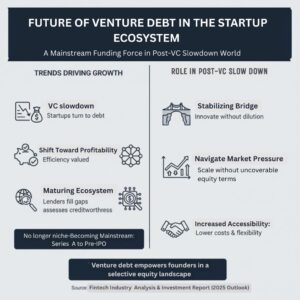
The future of venture debt looks promising. Several macro trends are contributing to its rapid rise:
- VC Slowdown: As equity markets tighten, startups turn to debt to maintain momentum.
- Shift Toward Profitability: Investors now value efficiency over growth at all costs. Debt aligns with this mindset.
- Maturing Ecosystems: As emerging markets develop, specialized lenders are stepping in to fill funding gaps.
- Tech-Driven Underwriting: AI and analytics now allow lenders to assess startup creditworthiness in real time.
This evolution means that venture debt is no longer just a niche instrument—it’s becoming mainstream, used by companies at every stage, from Series A to pre-IPO.
14.2 The Role of Venture Debt in a Post-VC Slowdown World
In a world where venture capital is more selective and valuations are under pressure, venture debt acts as a stabilizing bridge. It enables founders to continue innovating, scaling, and hiring without succumbing to unfavorable equity terms.
Moreover, as more institutional investors and banks enter the space, competition among lenders will likely drive down costs and increase flexibility, making venture debt an even more appealing option in the years ahead.