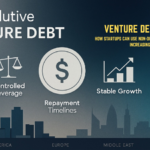
In 2025, startups across the globe are rethinking how they fund growth. With equity funding becoming more selective, valuations stabilizing, and venture capital firms prioritizing profitability over scale-at-all-costs, founders are increasingly turning to venture debt as a strategic financing option. Unlike traditional equity rounds, venture debt offers non-dilutive capital, allowing startups to extend runway, fund expansion, and preserve ownership—if used correctly.
However, venture debt is not risk-free. Interest rates, covenants, repayment structures, and regional differences can significantly impact a company’s financial health. This guide explains when venture debt makes sense, how it works, and how startups in the US, Europe, and the Middle East can use it effectively without increasing risk.
What Is Venture Debt and Why It Matters in 2025
Venture debt is a form of structured lending provided to venture-backed startups, typically alongside or shortly after an equity round. Unlike bank loans, venture debt providers focus less on historical profitability and more on the startup’s growth trajectory, investor backing, and future cash flow potential.
In 2025, venture debt has gained renewed relevance due to:
- Slower venture capital deployment
- Longer fundraising cycles
- Increased pressure to reduce dilution
- Higher cost of equity capital
Rather than replacing equity, venture debt is best used as a complementary financing tool—designed to enhance capital efficiency rather than fund core survival.

When Venture Debt Makes Strategic Sense
Venture debt is most effective when used at the right stage and for the right purpose. It works best for startups that already have institutional backing and predictable growth levers.
Venture debt is typically suitable when:
- The startup has recently closed a priced equity round
- Monthly burn is controlled and forecastable
- Revenue visibility exists (SaaS, fintech, healthtech, marketplaces)
- Funds are used for growth acceleration, not operational rescue
Common use cases include:
- Extending runway by 6–18 months
- Funding product expansion or geographic entry
- Bridging to the next equity round at a higher valuation
- Financing equipment, infrastructure, or working capital
Using venture debt to cover structural losses or declining revenues significantly increases risk and should be avoided.

How Venture Debt Works: Interest, Warrants, and Repayment
Understanding the mechanics of venture debt is critical before signing any agreement. While terms vary by lender and region, most venture debt facilities include three core components.
Interest Rates and Fees
Interest rates in 2025 typically range between 8% and 14% annually, depending on market conditions, credit profile, and region. Some lenders structure part of the interest as payment-in-kind (PIK), deferring cash outflow during the early months.
Additional costs may include:
- Origination fees (1–3%)
- End-of-term fees
- Legal and due diligence expenses
Warrants and Equity Upside
Most venture debt providers receive warrants, usually representing 0.5% to 2% equity coverage. While this introduces minor dilution, it is significantly lower than a traditional equity round.
Repayment Structure
Repayment commonly follows an interest-only period (6–12 months), followed by amortization over 24–36 months. This structure allows startups to deploy capital before repayment pressure begins.

Covenants: The Hidden Risk Founders Must Understand
Covenants are often underestimated but represent the biggest risk factor in venture debt agreements. These contractual conditions allow lenders to intervene if financial metrics deteriorate.
Common covenants include:
- Minimum cash balance requirements
- Monthly or quarterly revenue thresholds
- Restrictions on additional debt
- Limitations on acquisitions or major spending
In 2025, lenders are more flexible than traditional banks but still enforce covenants strictly. Founders should:
- Negotiate covenant headroom
- Align metrics with realistic forecasts
- Avoid aggressive growth assumptions
A covenant breach can trigger penalties, forced repayment, or renegotiation under unfavorable terms.
Venture Debt vs Equity: A Capital Efficiency Comparison
Venture debt is not a replacement for equity but a tool to optimize capital structure. Understanding when to use each is key to managing risk.
Key differences include:
- Equity dilutes ownership but has no repayment obligation
- Venture debt preserves equity but introduces fixed liabilities
- Equity absorbs downside risk; debt amplifies it if misused
In capital-efficient startups, venture debt can:
- Reduce dilution by 10–30% over multiple rounds
- Improve return on equity for founders and early investors
- Strengthen negotiating power in future equity raises
The safest approach is using venture debt after equity, not instead of it.
Regional Differences: Venture Debt Across the US, Europe, and the Middle East
Venture debt markets vary significantly by geography in terms of maturity, risk appetite, and legal structure.

United States
The US remains the most developed venture debt market. Specialized lenders and venture banks dominate the space, offering flexible structures tied closely to VC sponsorship.
Key characteristics:
- Larger ticket sizes
- Faster approvals
- Higher warrant expectations
- Sophisticated covenant frameworks
US startups commonly use venture debt as a routine part of their funding strategy rather than a last resort.
Europe
Europe’s venture debt market has expanded rapidly, especially in the UK, Germany, and the Nordics. However, lenders tend to be more conservative.
Notable traits include:
- Lower leverage multiples
- Stricter covenant enforcement
- Greater focus on unit economics
- Sector preference for SaaS, climate tech, and deep tech
European startups must demonstrate disciplined financial controls to access venture debt on favorable terms.
Middle East
The Middle East, particularly the UAE and Saudi Arabia, is an emerging venture debt market in 2025. Government-backed funds and regional financial institutions are increasingly active.
Key features:
- Limited warrant structures
- Relationship-driven lending
- Preference for revenue-generating startups
- Alignment with national innovation agendas
While still developing, the region offers attractive opportunities for startups with strong regional traction.
How to Use Venture Debt Without Increasing Risk
The biggest misconception about venture debt is that it automatically increases financial risk. In reality, poor execution increases risk—not the instrument itself.
Best practices for risk-managed venture debt include:
- Borrowing conservatively relative to cash runway
- Matching repayment schedules with revenue milestones
- Maintaining excess liquidity beyond covenant minimums
- Aligning debt maturity with the next equity event
Founders should also maintain transparent communication with lenders. Early disclosure of challenges often leads to flexibility, while surprises reduce trust.
Common Mistakes Startups Make With Venture Debt
Despite its advantages, venture debt can backfire if misused. In 2025, lenders report recurring mistakes that founders should actively avoid.
These include:
- Using venture debt to delay inevitable equity dilution
- Overestimating revenue growth projections
- Ignoring covenant implications during downturns
- Taking multiple debt facilities simultaneously
- Treating venture debt as “cheap money.”
Discipline, not optimism, determines success with non-dilutive capital.
The Future of Venture Debt in 2025 and Beyond
As global capital markets stabilize, venture debt is expected to become a permanent pillar of startup finance rather than a cyclical alternative. Increasing data availability, AI-driven credit assessment, and cross-border lending platforms are reshaping how venture debt is structured and priced.
For founders, this means:
- Greater access to customized debt solutions
- More competitive pricing
- Increased responsibility for financial governance
Startups that understand venture debt early will gain a structural advantage over peers who rely solely on equity funding.

Final Perspective
Venture debt in 2025 is no longer a niche financing option—it is a strategic tool for startups seeking growth without unnecessary dilution. When used thoughtfully, aligned with equity capital, and supported by realistic financial planning, venture debt can extend runway, enhance valuation, and preserve founder control without increasing risk.
The key is not whether to use venture debt, but how and when to deploy it responsibly.