The first half of 2025 has marked a major comeback for the global venture capital and startup acquisition markets. Fueled by relentless AI innovation, cybersecurity demand, and renewed investor confidence, venture funding and M&A activity have soared to levels not seen since 2021. According to Crunchbase, worldwide startup acquisitions reached more than $100 billion in H1 2025, a staggering 155% increase compared to the same period last year. Meanwhile, global venture funding totaled $91 billion in Q2 2025, reflecting an 11% year-over-year rise.
These numbers indicate not only a rebound in venture activity but also a shift in the investment landscape, as AI, data infrastructure, and cyber technologies dominate both funding and exit pipelines.
A Strong Rebound in Global Venture Funding
Global funding trends in early 2025 paint an optimistic picture. After two years of tighter capital and falling valuations, venture investors are back in action, with deal activity showing clear momentum in Q2. Crunchbase data suggests that overall H1 funding surpassed $205 billion, up nearly 32% year-over-year, demonstrating renewed interest from institutional and corporate investors.
While the total amount invested has increased, the number of deals remains lower, suggesting that investors are concentrating more capital into fewer, high-conviction startups. This means that although there are fewer checks being written, the ones that are tend to be larger and focused on proven companies with strong traction—especially those in artificial intelligence, data management, and security.
M&A Activity Hits Record High
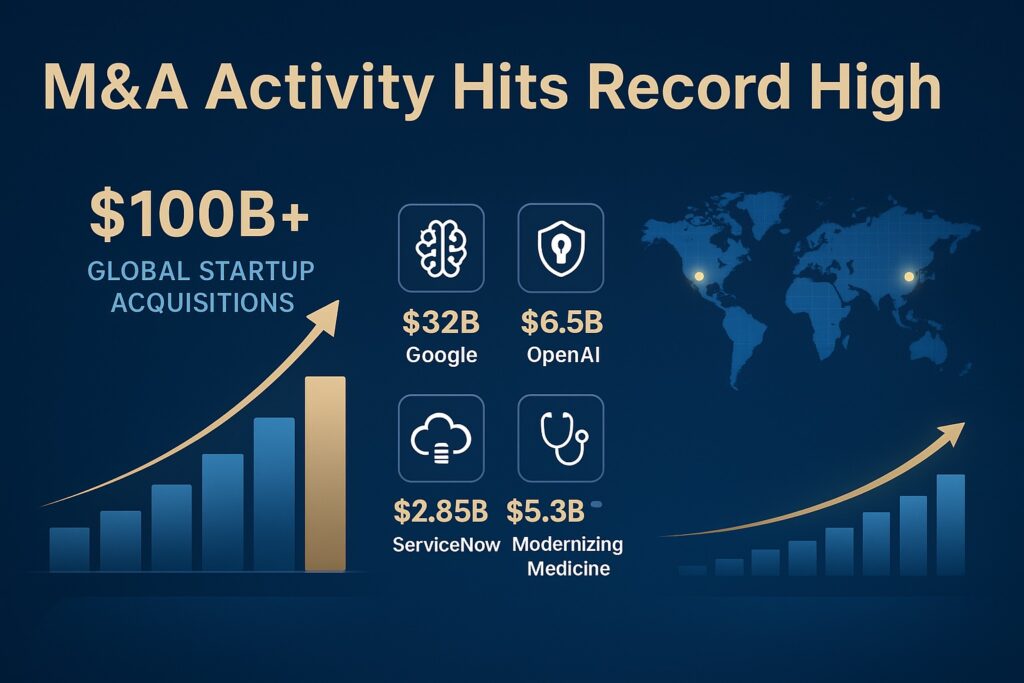
The M&A landscape is where the biggest surprises have emerged. In H1 2025, the global value of startup acquisitions exceeded $100 billion, marking the strongest half-year for exits since 2021. This growth is being driven by a mix of large corporate buyouts, startup-to-startup acquisitions, and strategic consolidations across high-growth industries.
Major Deals Defining the Market
Among the standout deals:
- Google’s $32 billion purchase of Wiz, a cybersecurity unicorn, made headlines as Alphabet’s largest-ever acquisition.
- OpenAI’s acquisition of Jony Ive’s AI hardware venture, Io, for approximately $6.5 billion underscored the company’s move into next-gen AI devices.
- ServiceNow’s $2.85 billion buyout of Moveworks and Xero’s $2.5 billion acquisition of Melio further demonstrated the appetite for enterprise-focused technologies.
- In healthcare, Modernizing Medicine sold a majority stake at a $5.3 billion valuation, signaling renewed confidence in digital health innovation.
Rise of Startup-to-Startup Acquisitions
What’s particularly interesting is the rise of startup-to-startup acquisitions. Over 420 such deals were reported in H1 2025, up nearly 18% from 2024, as young companies seek to combine resources, talent, and technologies to accelerate growth in an increasingly competitive market. This trend shows that founders are not waiting for perfect fundraising conditions—they’re using M&A as a strategy to achieve scale faster.
Regional Trends Shaping Global Investment
North America Maintains Leadership
Regional dynamics reveal shifting patterns in where venture money is flowing. North America continues to dominate, accounting for roughly 70% of global VC funding in H1 2025. The United States remains the epicenter of mega-rounds, led by AI powerhouses like OpenAI, Anthropic, and Scale AI. Meta’s $14.3 billion investment in Scale AI was one of the largest venture transactions of the quarter.
Europe and Latin America’s Mixed Momentum
Europe, however, has experienced a mixed performance. While overall funding has softened, countries like Germany have overtaken the U.K. in deal count for the first time in over a decade, signaling a gradual shift in Europe’s startup geography. Latin America saw notable resilience, with venture activity growing 16% year-over-year, and Mexico surpassing Brazil as the region’s top startup hub.
Asia Faces Regulatory Challenges
In Asia, however, conditions remain challenging. Chinese venture activity continues to decline due to regulatory uncertainty and global investor caution, with only about $5 billion in funding reported in Q2 2025. Still, emerging markets such as India and Singapore are attracting steady investor interest, particularly in fintech and climate tech sectors.
AI and Cybersecurity Take Center Stage
From a sectoral standpoint, AI reigns supreme as the most funded and most acquired technology category of 2025. Nearly half of all capital deployed in Q2 went to AI-related startups, spanning from foundational model developers to enterprise AI tools and infrastructure platforms.
The cybersecurity sector also saw explosive activity following Google’s Wiz acquisition, which boosted investor confidence in defensive technologies. Analysts say the growing overlap between AI and cyber — such as automated threat detection and AI-driven security analytics — has created new value chains for investors and acquirers alike.
Beyond AI and cyber, fintech, biotech, and healthtech sectors have also regained momentum. However, investor enthusiasm remains strongest for technologies that complement or enable AI-driven ecosystems — including cloud infrastructure, data management, and digital identity.
Implications for Founders and Investors
What Founders Should Focus On
For founders, the 2025 market presents both opportunity and complexity. Those who can demonstrate clear product-market fit and operational discipline are well-positioned to raise capital or attract acquisition interest. With buyers willing to pay premiums for strategic assets, being exit-ready has never been more critical.
Startups should focus on building defensible technology, revenue predictability, and strategic optionality — meaning they can either raise another round or be acquired on favorable terms. As capital markets remain selective, investors prefer companies with scalable unit economics and a strong AI or cybersecurity component.
How Investors Are Responding
For venture investors, the mid-2025 environment emphasizes quality over quantity. The data clearly shows that mega-rounds dominate total funding, suggesting a bifurcation of the market — where top-tier companies receive outsized capital while smaller startups face tighter conditions. Investors who diversify across sectors and maintain disciplined valuation strategies are best equipped to navigate this concentrated landscape.
Moreover, with M&A activity at historic highs, private equity and corporate venture arms are expected to play larger roles in late-stage financing, blurring the traditional lines between venture funding and strategic buyouts.
Risks and Market Outlook
Despite the optimism, risks remain. Overexposure to AI and inflated valuations could lead to a correction if growth expectations aren’t met. Rising interest rates, regulatory interventions, and geopolitical uncertainty may also introduce volatility into funding cycles. However, experts note that the ecosystem is more mature than in previous boom periods, with greater capital efficiency and investor discipline guiding dealmaking.
The key challenge for 2025 and beyond will be maintaining this growth momentum while avoiding the pitfalls of speculative exuberance. For founders, that means focusing on execution and sustainability. For investors, it’s about balancing conviction with caution — staying bullish on innovation, but grounded in fundamentals.
Conclusion
In summary, H1 2025 marks a clear turning point for the global startup economy. Venture investment and M&A activity have roared back to life, powered by AI breakthroughs, cybersecurity demand, and strategic consolidation across industries. With $91 billion raised in Q2 and $100 billion+ in exits, the startup world has entered a new phase of growth and maturity.
The coming months will test whether this momentum is sustainable — but for now, the data tells a compelling story: the innovation economy is back on offense.