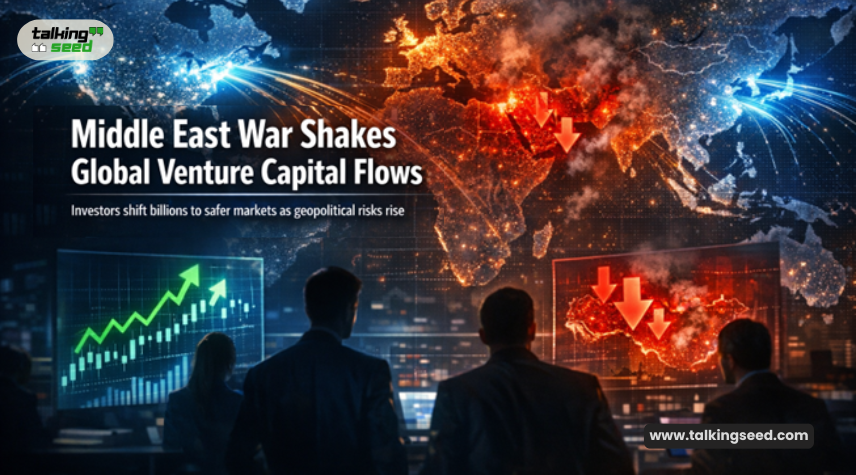
The escalating war in the Middle East is sending immediate shockwaves through global venture capital (VC) markets, forcing investors to retreat from high-risk regions and redirect billions toward more stable economies such as the United States and Europe.
What initially appeared to be a localized geopolitical crisis has rapidly evolved into a global financial concern, disrupting startup funding pipelines, delaying major deals, and triggering a sharp reassessment of risk across venture portfolios.
Global Investors Hit the Brakes on Middle East Exposure
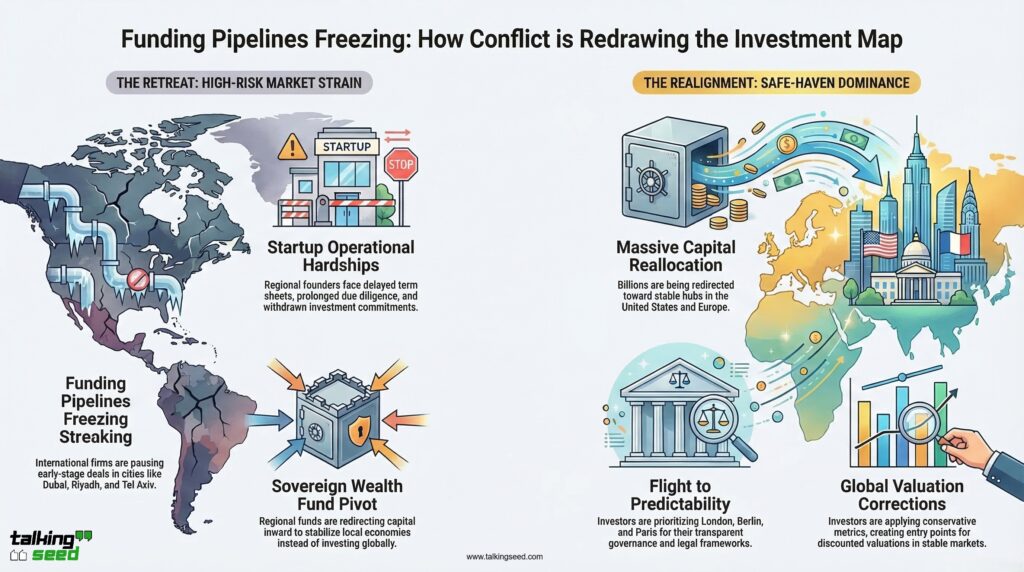
Within weeks of intensifying conflict, several international venture capital firms have either paused or significantly slowed investments linked to the Middle East. Analysts report a noticeable decline in cross-border funding activity, particularly in early-stage deals where risk tolerance is typically higher.
“Geopolitical instability creates layers of uncertainty that venture capital simply cannot ignore,” said a senior partner at a London-based investment firm. “From currency fluctuations to regulatory unpredictability, everything becomes harder to model.”
Startups in affected regions are already feeling the strain. Founders report delayed term sheets, prolonged due diligence processes, and, in some cases, withdrawn commitments.
Capital Rapidly Shifting to Safe-Haven Ecosystems
As geopolitical risk intensifies, global VC funds are swiftly reallocating capital to markets perceived as stable and predictable. The United States continues to dominate as a primary destination, with Silicon Valley regaining momentum after a relatively cautious 2025.
European startup hubs, including London, Berlin, and Paris, are also witnessing renewed investor interest. Venture firms are prioritizing ecosystems with strong legal frameworks, transparent governance, and lower geopolitical exposure.
This shift is not merely defensive. Investors are actively seeking opportunities to capitalize on discounted valuations in stable markets, where startup fundamentals remain strong despite global uncertainty.
Middle East Startup Funding Faces Sudden Slowdown
The Middle East, once one of the fastest-growing startup ecosystems globally, is now confronting a sharp funding slowdown. Cities such as Dubai, Riyadh, and Tel Aviv—previously magnets for venture capital—are seeing reduced deal flow and declining investor participation.
Industry insiders note that seed and Series A rounds have been particularly affected. Early-stage startups, which depend heavily on continuous capital inflows, are now facing extended fundraising cycles and tighter investor scrutiny.
“There’s still interest, but the appetite for risk has clearly dropped,” said a regional venture analyst. “Investors want more proof, more traction, and more certainty before committing funds.”
Sovereign Wealth Funds Rebalance Priorities
Sovereign wealth funds (SWFs) from the Middle East—long considered major drivers of global venture capital—are also adjusting their strategies in response to the crisis.
With increasing domestic economic pressures and heightened uncertainty, several SWFs are shifting focus toward stabilizing local economies and safeguarding existing assets. This recalibration is expected to reduce outbound investments, tightening global liquidity in the VC ecosystem.
The ripple effect is significant. Many global startups that previously relied on Middle Eastern capital are now exploring alternative funding sources, intensifying competition in already crowded markets.
Startup Valuations Begin to Correct
The uncertainty surrounding the conflict is also impacting startup valuations worldwide. Investors are applying more conservative metrics, factoring in geopolitical risk alongside traditional financial indicators.
Startups with exposure to affected regions or vulnerable supply chains are experiencing downward pressure on valuations. Sectors such as logistics, travel, and cross-border commerce are among the hardest hit.
At the same time, some investors view the correction as an opportunity. Lower valuations are creating entry points for funds willing to navigate the risks and invest with a long-term perspective.
Sector-Wise Investment Trends Undergo Realignment
The crisis is accelerating a shift in sectoral investment trends, with capital flowing toward industries that offer resilience in uncertain times.
Cybersecurity and Defense Technology:
Rising geopolitical tensions have fueled demand for advanced security solutions. Venture capital is increasingly flowing into startups specializing in cybersecurity, surveillance, and defense innovation.
Energy and Climate Technology:
Disruptions in the Middle East—a critical global energy hub—are prompting renewed focus on alternative energy solutions. Investors are backing startups that enhance energy security and sustainability.
Fintech and Digital Systems:
Financial volatility is driving interest in fintech platforms that ensure secure, efficient, and scalable financial transactions. Startups offering cross-border payment solutions and digital banking infrastructure are gaining traction.
Asia Emerges as an Alternative Investment Destination
As capital exits high-risk zones, parts of Asia are emerging as attractive alternatives. India and Southeast Asia, in particular, are witnessing increased venture capital inflows as investors diversify their geographic exposure.
These regions offer a combination of high growth potential, expanding digital economies, and relatively stable political environments—making them appealing destinations amid global uncertainty.
Market analysts suggest that this shift could have long-term implications, accelerating the rise of new global startup hubs outside traditional Western strongholds.
Global Venture Capital Trends Show Clear Divergence
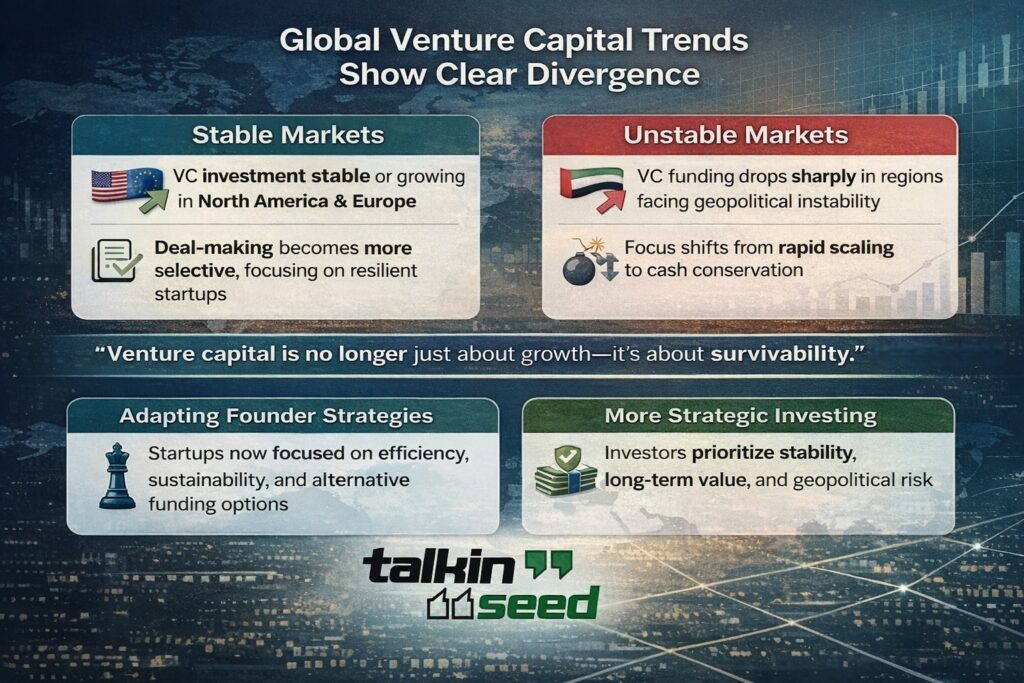
Recent data indicate a growing divide in global venture capital trends. While investment volumes remain stable or even increase in North America and Europe, regions affected by geopolitical instability are experiencing a sharp decline in funding activity.
Deal-making is becoming more selective, with investors prioritizing startups that demonstrate strong fundamentals, clear revenue models, and resilience to external shocks.
“Venture capital is no longer just about growth—it’s about survivability,” noted a senior analyst at a global research firm.
Founders Adapt to a New Funding Reality
Startup founders are responding to the changing landscape by adjusting strategies to conserve cash and extend runway. Cost optimization, operational efficiency, and revenue generation are now taking precedence over aggressive expansion.
Many startups are also exploring alternative funding options, including venture debt, strategic partnerships, and internal restructuring, to navigate the funding slowdown.
The emphasis has shifted from rapid scaling to sustainable growth—a trend that could redefine startup culture in the years ahead.
A Defining Moment for Global Venture Capital
The Middle East war is proving to be a defining moment for the global venture capital ecosystem. It has exposed vulnerabilities, reshaped investment priorities, and highlighted the critical role of geopolitical stability in financial decision-making.
As investors continue to rebalance portfolios, the focus is increasingly on stability, resilience, and long-term value creation. The era of unchecked risk-taking appears to be giving way to a more disciplined and cautious approach.
Strategic Shifts Likely to Outlast the Crisis
While the immediate impact of the conflict is clear, its long-term effects are expected to persist. Venture capital firms are likely to incorporate geopolitical risk as a core component of investment strategy, influencing decisions well beyond the current crisis.
This could lead to a more diversified global investment landscape, with capital distributed across multiple stable regions rather than concentrated in a few high-growth but high-risk markets.
Global Capital Redefined by Crisis
The ongoing Middle East conflict has underscored a fundamental reality: in an interconnected world, geopolitical events can rapidly reshape financial ecosystems.
For venture capital, the message is clear. Stability is no longer optional—it is essential. As the crisis continues to unfold, the global flow of capital is being redrawn in real time, setting the stage for a new era of investment strategy defined as much by geopolitics as by innovation.
The full impact is still unfolding, but one outcome is already certain—the rules of global venture capital are changing.