
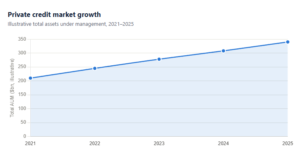
Private credit has become a significant component of the global credit market, connecting borrowers with lenders outside traditional bank lending and public debt markets. It covers a broad range of privately negotiated financing, from senior secured direct lending and asset-backed finance to mezzanine, distressed and special-situation strategies.
For borrowers, private credit can provide a tailored source of capital where conventional bank financing or public-market issuance may not fit the transaction. For lenders and investors, it creates exposure to contractual credit assets that can be originated, managed, refinanced, restructured and, in some cases, transferred through the secondary market.
The market is therefore more than a collection of private loans. It is an interconnected ecosystem involving origination, underwriting, structuring, valuation, servicing, monitoring, portfolio management and secondary transactions.
For participants involved in buying and selling debt, private credit is particularly relevant because an existing loan can become a transferable financial asset. Once originated, a credit exposure may remain on the original lender’s balance sheet, move into an investment vehicle, be refinanced, or become part of a portfolio offered to another buyer.
Understanding how private credit works requires looking at the entire lifecycle of the asset—from the initial financing requirement through ownership, performance, servicing and eventual repayment, restructuring or sale.
What Is Private Credit?
Private credit is financing provided through privately negotiated debt arrangements, generally by non-bank lenders such as private credit funds, alternative asset managers, institutional investors and specialist finance providers.
Unlike publicly traded debt, private credit transactions are typically negotiated directly between the borrower and lender. The terms can therefore be structured around the characteristics of the borrower and the financing requirement.
A private credit facility may specify:
- Principal amount
- Interest and pricing structure
- Maturity
- Repayment terms
- Collateral and security
- Financial covenants
- Reporting obligations
- Guarantees
- Default provisions
- Prepayment conditions
- Fees
- Transfer restrictions
The underlying assets can vary considerably. A private credit portfolio might contain loans to established businesses, growth companies, asset-backed borrowers or companies undergoing restructuring.
This creates an important distinction between private credit as an asset class and a single lending strategy.
Private credit can include:
Direct Lending
Loans provided directly to businesses, often as senior secured or unitranche facilities.
Asset-Based Finance
Financing supported by identifiable assets, receivables or other pools of collateral.
Mezzanine Credit
Financing positioned between senior debt and equity within the capital structure.
Distressed Credit
Loans or credit exposures associated with borrowers experiencing financial stress or restructuring.
Special Situations
Financing opportunities involving acquisitions, restructurings, recapitalisations or other complex situations.
The common characteristic is that the credit exposure is privately originated or privately negotiated rather than issued as a standard publicly traded security.
The Private Credit Market Structure
Private credit operates across several interconnected layers.
At the beginning is the borrower, which requires capital.
The borrower is assessed by a lender or investment manager, which determines whether the opportunity fits its investment strategy and risk parameters.
Capital may then come from institutional investors or investment vehicles that provide the funding used by the lender.
Once the loan is completed, servicers and portfolio managers support administration, monitoring and reporting.
If the borrower experiences financial stress, restructuring, legal and recovery specialists may become involved.
Finally, the credit exposure may be repaid, refinanced or transferred to another investor through a secondary transaction.
A simplified structure is:
Capital Providers → Private Credit Manager → Borrower → Servicing & Monitoring → Repayment / Restructuring / Secondary Sale
This structure makes private credit closely connected to the wider debt market.
How Private Credit Works
A private credit transaction normally begins with a financing requirement.
The borrower may need capital for expansion, acquisition, refinancing, working capital, recapitalisation or another strategic purpose.
The lender then moves through a structured underwriting process.
1. Opportunity Identification
Potential transactions may originate through direct relationships, advisers, investment banks, intermediaries, existing portfolio relationships and specialist origination channels.
2. Initial Screening
The lender determines whether the opportunity fits its investment mandate.
Key considerations may include:
- Borrower sector
- Business model
- Revenue profile
- Existing debt
- Leverage
- Cash-flow generation
- Financing requirement
- Collateral
- Proposed structure
3. Credit Underwriting
The lender analyses the borrower’s ability to meet its obligations under different operating and financial scenarios.
4. Structuring
The financing is structured around the borrower’s requirements and the lender’s desired level of protection.
5. Due Diligence
Financial, legal, commercial and operational information is reviewed before the transaction progresses.
6. Pricing
The lender establishes pricing based on the expected risk and economics of the transaction.
7. Documentation and Closing
Legal agreements, security documents and other transaction documentation are completed before funding.
8. Portfolio Management
After funding, the loan becomes an actively managed credit exposure.
Payments, financial performance, covenants and borrower developments are monitored throughout the investment period.
9. Exit or Resolution
The loan may reach maturity, be refinanced, repaid, restructured or sold.
This lifecycle is what differentiates private credit from a simple one-time lending transaction.
Key Private Credit Strategies
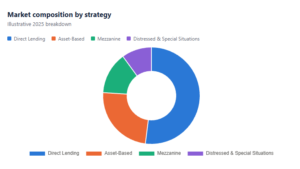
The private credit market contains multiple strategies because borrowers have different financing requirements and investors have different risk and return objectives.
Direct Lending
Direct lending is one of the most established areas of private credit.
A lender provides financing directly to a company, generally with negotiated terms covering interest, maturity, security and financial covenants.
The structure may be senior secured, unitranche or another form of private financing.
Direct lending is particularly relevant when a borrower requires financing that is more customised than a conventional bank facility.
Senior Secured Credit
Senior secured loans generally have priority over subordinated debt and may be supported by collateral.
The precise rights of the lender depend on the transaction documents, security arrangements and applicable law.
When evaluating these loans, investors may examine:
- Quality of collateral
- Security position
- Loan-to-value considerations
- Cash-flow capacity
- Covenant structure
- Recovery expectations
Security can provide an additional layer of protection, but it does not eliminate credit or recovery risk.
Unitranche Financing
A unitranche facility combines different layers of debt into a single financing structure.
For borrowers, this can simplify the capital structure and reduce the number of separate lenders involved in the transaction.
For investors, the analysis focuses on the overall structure, pricing, protections, repayment capacity and position within the capital stack.
Mezzanine and Subordinated Credit
Mezzanine financing generally occupies a position below senior debt and above equity.
Because of its position in the capital structure, the risk profile can differ from senior secured lending.
Investors may consider:
- Cash-flow strength
- Subordination
- Equity cushion
- Contractual protections
- Expected repayment
- Potential recovery
Asset-Based Private Credit
Asset-based lending uses identifiable assets or receivables to support financing.
Potential underlying assets can include:
- Accounts receivable
- Inventory
- Equipment
- Property
- Consumer receivables
- Other contractual cash flows
The quality, ownership, liquidity and enforceability of the underlying assets are central to underwriting.
Private Credit Underwriting
Underwriting is the foundation of private credit investing.
The purpose is not simply to determine whether a borrower can obtain financing. It is to understand how the credit behaves under different conditions and what protections exist if performance changes.
A robust underwriting process may examine five broad areas.
Business
What does the borrower do, how does it generate revenue and what factors influence its business performance?
Financial
What are the borrower’s historical and projected revenues, earnings, cash flow, liquidity and debt obligations?
Structure
How is the proposed financing positioned within the capital structure?
Security
What assets support the facility, and what rights does the lender have over those assets?
Downside
What happens if revenue declines, costs increase, refinancing becomes difficult or the borrower defaults?
The last question is particularly important.
Private credit analysis should not focus only on the expected case. Understanding downside scenarios is essential to evaluating potential recovery and loss exposure.
Private Credit Due Diligence
Due diligence transforms borrower information into an investment assessment.
Financial Due Diligence
Financial review can cover:
- Historical financial statements
- Revenue quality
- Cash-flow generation
- Debt obligations
- Liquidity
- Working capital
- Forecast assumptions
- Capital expenditure
- Existing financing
The objective is to understand the borrower’s ability to generate sufficient cash to meet its obligations.
Legal Due Diligence
Legal review may examine:
- Loan agreements
- Security documents
- Guarantees
- Corporate authority
- Covenants
- Default provisions
- Transfer provisions
- Enforcement rights
Commercial Due Diligence
Commercial analysis considers the underlying business, including its market position, customers, competitors and revenue drivers.
Operational Due Diligence
Operational analysis can examine systems, management processes, reporting capabilities, technology and the infrastructure supporting the borrower.
Collateral Due Diligence
Where credit is secured, the underlying collateral may require separate analysis.
The value of collateral depends on factors such as ownership, quality, liquidity, marketability and enforceability.
Private Credit Pricing and Valuation
The outstanding balance of a private loan is not necessarily the same as its economic value.
A private credit investment is generally evaluated based on the expected future cash flows and the risks associated with receiving those cash flows.

A simplified framework is:
Principal + Expected Interest → Timing → Credit Risk → Costs → Recovery Expectations → Estimated Value
Several variables influence the valuation.
Expected Cash Flows
The lender considers the expected interest and principal payments.
Timing of Cash Flows
A payment received sooner and a payment received later do not have the same economic value.
Credit Quality
The borrower’s financial position influences the probability that scheduled payments will be received.
Recovery
If default occurs, potential recovery from collateral or other sources affects the expected value.
Costs
Servicing, administration, legal and recovery costs can affect net proceeds.
Market Conditions
Interest rates, credit spreads, liquidity and investor demand can influence the price at which a private credit exposure may transact.
For a portfolio, these factors may be assessed at both loan level and portfolio level.
Private Credit Portfolio Management
Private credit does not end when capital is deployed.
Ongoing portfolio management is responsible for identifying changes in credit quality and ensuring that relevant information reaches the investment team.
Typical monitoring areas include:
- Payment performance
- Financial results
- Liquidity
- Covenant compliance
- Borrower reporting
- Collateral
- Industry developments
- Refinancing requirements
- Credit deterioration
A portfolio manager may classify exposures according to their current performance and level of monitoring required.
This creates a dynamic portfolio rather than a static collection of loans.
A performing loan may continue under normal monitoring. Another exposure may require enhanced monitoring, restructuring discussions or recovery planning.
Private Credit Servicing
Servicing provides the operational infrastructure behind a credit portfolio.
Depending on the structure, servicing can include:
- Payment collection
- Loan administration
- Account reconciliation
- Borrower communication
- Reporting
- Document management
- Covenant tracking
- Portfolio data management
- Collections
- Recovery administration
Accurate servicing information is particularly important when a credit portfolio is being evaluated for refinancing or sale.
A potential buyer may need access to historical payment information, outstanding balances, documentation, borrower details, security information and recovery history.
In this way, servicing data becomes part of the investment asset.
Private Credit and the Secondary Market
One of the most important aspects of private credit for debt-market participants is the possibility of secondary transactions.

A loan does not necessarily remain with its original lender until maturity.
Subject to contractual transfer restrictions and applicable requirements, an existing credit exposure can potentially be transferred or sold to another investor.
The transaction may involve:
Existing Lender → Portfolio Preparation → Buyer Review → Due Diligence → Valuation → Negotiation → Transfer → Servicing
This creates a secondary market for privately originated credit assets.
For sellers, a secondary transaction can support portfolio management objectives such as:
- Rebalancing
- Liquidity management
- Concentration management
- Fund-level portfolio adjustments
- Strategy changes
- Risk management
For buyers, secondary transactions can provide access to existing credit exposures rather than requiring every investment to originate from scratch.
Buying and Selling Private Credit Portfolios
A private credit portfolio transaction requires significantly more than agreeing on a purchase price.
The quality and completeness of the underlying data can directly affect the buyer’s ability to assess the portfolio.
Portfolio Preparation
The seller typically organises:
- Loan-level data
- Borrower information
- Payment history
- Outstanding balances
- Loan documentation
- Security information
- Covenant information
- Servicing records
Buyer Screening
Potential buyers assess whether the portfolio fits their investment strategy.
They may consider:
- Asset type
- Geography
- Borrower profile
- Credit quality
- Portfolio size
- Expected recovery
- Risk profile
Due Diligence
The buyer conducts a detailed review of the portfolio.
Valuation
Expected cash flows, risk, costs, recoveries, and timing are incorporated into the valuation.
Negotiation
The parties negotiate:
- Purchase price
- Transfer conditions
- Representations
- Warranties
- Indemnities
- Closing requirements
- Servicing arrangements
Transfer and Servicing
Once completed, ownership and associated documentation are transferred according to the transaction structure.
Servicing may remain with the existing provider or move to another servicer.
Private Credit in Distressed Situations
Private credit becomes particularly complex when a borrower begins to experience financial stress.
Potential warning signs can include:
- Missed or delayed payments
- Declining cash flow
- Covenant breaches
- Increased leverage
- Liquidity pressure
- Refinancing difficulties
- Deteriorating collateral values
The lender may then evaluate options such as:
Monitor → Engage → Restructure → Refinance → Enforce → Recover
The appropriate response depends on the transaction documents, borrower circumstances, available collateral and applicable legal framework.
Distressed situations can also create opportunities for investors seeking to acquire credit exposures at different stages of the recovery process.
Private Credit Risk Framework
Private credit involves multiple layers of risk.
Credit Risk
The borrower may not make scheduled payments or repay principal.
Concentration Risk
A portfolio concentrated in a particular borrower, sector, geography or asset type can have greater exposure to specific events.
Liquidity Risk
Private credit investments generally do not have the same liquidity as publicly traded securities.
Interest Rate Risk
Changes in interest rates can affect borrowing costs, pricing and portfolio economics.
Recovery Risk
Actual recoveries may differ from initial assumptions.
Documentation Risk
The lender’s rights depend on the specific contractual and legal framework.
Operational Risk
Weak servicing, data or reporting processes can reduce portfolio visibility and affect decision-making.
Risk management therefore needs to continue throughout the investment lifecycle rather than stopping at origination.
Technology and Data in Private Credit
Technology is changing how private credit portfolios are originated, analysed and managed.
Digital systems can support:
- Loan origination
- Credit underwriting
- Data validation
- Portfolio monitoring
- Cash-flow analysis
- Valuation
- Servicing
- Reporting
- Risk management
- Secondary-market transactions
For portfolio buyers, structured data can significantly improve the due-diligence process.
Instead of reviewing every asset manually from disconnected documents, buyers can use standardised portfolio information to identify trends, compare exposures and focus deeper analysis on specific loans.
The result is a more connected credit lifecycle:
Origination → Data → Underwriting → Portfolio Management → Valuation → Transaction → Servicing → Recovery
Private Credit and Debt Portfolio Trading
Private credit has a direct relationship with the broader debt sale and purchase market.
A credit asset can move through several ownership stages during its lifecycle.
For example:
Originated by Lender → Held in Portfolio → Repriced or Restructured → Offered for Sale → Acquired by Investor → Serviced → Recovered or Exited
This makes private credit relevant not only to lenders and borrowers but also to:
- Debt buyers
- Institutional investors
- Asset managers
- Portfolio servicers
- Collection agencies
- Recovery specialists
- Secondary-market intermediaries
The secondary market provides a mechanism through which existing credit exposures can change ownership and strategy.
For debt marketplaces, this creates an opportunity to connect credit supply with potential buyers while providing the data and transaction infrastructure needed to support informed portfolio decisions.
Private Credit Portfolio Evaluation Framework
When evaluating a private credit portfolio, the most useful approach is to look at the asset from several connected perspectives rather than relying on a single valuation metric.
Portfolio Composition
What types of loans make up the portfolio?
Credit Performance
How are the underlying borrowers performing?
Cash Flow
What cash flows are expected and when?
Security
What collateral and contractual protections exist?
Documentation
Are the loan and security documents complete and enforceable?
Servicing
Who manages the portfolio and how reliable is the servicing infrastructure?
Recovery
What are the potential outcomes if individual exposures deteriorate?
Transferability
Can the assets be transferred, and what restrictions apply?
Marketability
Is there potential demand from other credit investors?
This framework helps connect credit quality, operational readiness and transaction value.