The NPL market is an important part of the global credit ecosystem, providing a secondary market where non-performing loans can be sold, purchased, managed, and recovered. As lending activity increases and credit conditions change, financial institutions may accumulate portfolios of loans that are no longer performing according to their original repayment terms. These assets can create operational, financial, and balance-sheet challenges for lenders.
The sale of non-performing loans provides lenders with an alternative to retaining and managing distressed exposures over an extended period. At the same time, the NPL market creates opportunities for specialist debt buyers, institutional investors, credit funds, and other investors to acquire portfolios based on their expected recovery potential.
NPL transactions involve more than agreeing on a purchase price. Buyers need to assess portfolio data, borrower profiles, payment history, legal enforceability, collateral, recovery performance, servicing requirements, and market conditions. Sellers, meanwhile, need to prepare accurate portfolio information and establish a transaction process that allows qualified buyers to assess the assets effectively.
This guide explains how the NPL market works, how NPL portfolios are bought and sold, how pricing and valuation are determined, and the key considerations for participants in the market.
What Is the NPL Market?
The NPL market, or non-performing loan market, is the secondary market for loans where borrowers have failed to meet their contractual repayment obligations or where the lender has determined that full repayment is unlikely under the applicable definition of a non-performing exposure.
NPLs can arise across almost every major lending segment. They may include consumer credit, personal loans, credit cards, mortgages, vehicle finance, SME lending, corporate loans, commercial real estate loans, and other forms of secured or unsecured credit.
The market allows lenders and other creditors to transfer these assets to buyers that specialize in distressed credit and portfolio management.
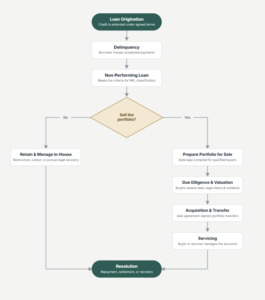
A simplified NPL lifecycle is:
Loan Origination → Delinquency → Non-Performing Loan → Portfolio Management → NPL Sale or Recovery → Servicing → Final Recovery
Not every non-performing loan is sold. A lender may decide to continue managing an account internally, restructure the debt, appoint an external collection agency, pursue legal recovery, or sell the exposure to another party.
When an NPL portfolio is offered for sale, potential buyers analyse the portfolio to determine its expected recovery potential. The outstanding balance of the loans is only one part of this assessment. Buyers also consider how much may realistically be recovered, how quickly recoveries may occur, and what costs will be required to achieve those recoveries.
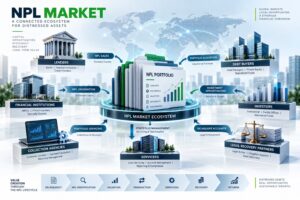
The NPL market therefore creates a connection between credit originators, debt sellers, investors, debt purchasers, servicers, collection agencies, and legal recovery providers.
The development of the secondary market also allows financial institutions to manage distressed assets through portfolio-level transactions rather than managing every account individually over the entire recovery lifecycle.
For buyers, the market can provide access to portfolios where the acquisition price reflects the risk and uncertainty associated with future recoveries. For sellers, an NPL transaction can provide liquidity and allow them to transfer the management of selected distressed exposures.
The structure and operation of the NPL market vary between countries because regulations, insolvency procedures, consumer protection requirements, debt assignment rules, and recovery processes differ by jurisdiction.
How the NPL Market Works
An NPL transaction normally follows a series of stages, beginning with the identification of a portfolio and ending with servicing and recovery.
Portfolio Identification
The process begins when a lender or creditor identifies a group of loans that may be suitable for sale.
Portfolio selection can be based on:
- Days past due
- Loan type
- Outstanding balance
- Historical recovery performance
- Geographic location
- Customer segment
- Legal status
- Security or collateral
- Internal portfolio strategy
The seller may create a portfolio specifically for sale or combine accounts with similar characteristics into a larger transaction.
Portfolio Preparation
Before approaching buyers, the seller needs to prepare the portfolio data.
A typical NPL data tape may contain:
- Account reference
- Loan type
- Original balance
- Current outstanding balance
- Principal outstanding
- Interest and fees
- Origination date
- Delinquency status
- Days past due
- Last payment date
- Payment history
- Borrower information
- Contact information
- Legal status
- Security details
- Previous collection activity
The quality of the data is important because buyers use this information to assess portfolio value and expected recoveries.
Buyer Due Diligence
Potential buyers review the available information before making an offer.
Due diligence may cover:
- Portfolio data
- Loan documentation
- Historical collections
- Legal enforceability
- Collateral
- Borrower characteristics
- Recovery performance
- Servicing requirements
- Regulatory considerations
Depending on the size and complexity of the transaction, buyers may also conduct sample-level reviews and independent validation of the seller’s information.
Valuation and Bidding
After analysing the portfolio, buyers develop their valuation models.
They estimate expected future recoveries and deduct the costs and risks associated with obtaining those recoveries.
The buyer may then submit an indicative or final offer.
Transaction Completion
Once a buyer is selected, the parties negotiate the final transaction documentation.
This can include:
- Sale and purchase agreements
- Assignment documentation
- Representations and warranties
- Data-transfer arrangements
- Servicing agreements
- Regulatory requirements
- Payment and settlement arrangements
After completion, the portfolio is transferred according to the agreed transaction structure.
Servicing and Recovery
The buyer may manage the portfolio internally or appoint a specialist servicer.
The servicer can manage:
- Customer communication
- Payment arrangements
- Collections
- Account administration
- Payment processing
- Reporting
- Complaints
- Legal recovery coordination
The recovery strategy will depend on the type and characteristics of the acquired portfolio.
Key Participants in the NPL Market
The NPL market brings together several groups with different responsibilities and objectives.
Banks and Financial Institutions
Banks are major participants in the NPL market because they originate large volumes of consumer, mortgage, SME, and corporate credit.
When loans become non-performing, banks may choose to retain them, restructure them, manage them through internal or external collections, or sell portfolios to specialist buyers.
Debt Sellers
The seller may be a bank, financial institution, non-bank lender, credit provider, or another organization holding the economic rights to a portfolio of distressed debt.
The seller’s objective may include reducing exposure to non-performing assets, generating liquidity, simplifying portfolio management, or reallocating internal resources.
NPL Investors
NPL investors provide capital to acquire portfolios and seek returns through future recoveries.
Participants may include:
- Institutional investors
- Private equity firms
- Credit funds
- Distressed-debt investors
- Specialist investment firms
- Family offices
Debt Buyers
Debt buyers acquire NPL portfolios and become responsible for managing the purchased assets according to the applicable legal and transaction structure.
Some buyers operate their own servicing infrastructure, while others use third-party servicers.
NPL Servicers
Servicers manage the day-to-day operation of acquired portfolios.
Their responsibilities can include customer contact, payment processing, collections, reporting, account management, and coordination with legal service providers.
Collection and Recovery Agencies
Specialist collection agencies can support debt buyers and servicers by providing customer engagement, skip tracing, field collections, digital collections, and other recovery services.
Legal and Advisory Firms
NPL transactions may require legal, financial, tax, valuation, and transaction advisory expertise, particularly where portfolios involve multiple jurisdictions, secured assets, or complex legal structures.
NPL Buying and Selling
The buying and selling of NPL portfolios is at the centre of the secondary debt market.
For sellers, the process begins with identifying which assets are appropriate for disposal. The seller then prepares portfolio information and approaches potential buyers.
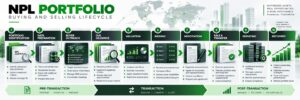
A typical transaction may follow this sequence:
Portfolio Selection → Data Preparation → Buyer Outreach → NDA → Data Room → Due Diligence → Valuation → Bidding → Negotiation → Sale Agreement → Transfer → Servicing
Selling an NPL Portfolio
A seller preparing a portfolio for sale should focus on providing buyers with sufficient information to understand the assets.
Important areas include:
- Accurate account balances
- Complete payment history
- Clear delinquency information
- Reliable borrower data
- Documentation availability
- Legal status
- Collateral information
- Historical recovery results
- Existing servicing arrangements
A clear and well-organized data room can make the due diligence process more efficient.
The seller may approach several potential buyers to obtain competing offers or negotiate directly with a selected investor.
The transaction structure can vary depending on portfolio size, asset type, jurisdiction, and the objectives of the seller.
Buying an NPL Portfolio
For buyers, purchasing an NPL portfolio requires detailed analysis before capital is committed.
The buyer needs to understand:
- What assets are being purchased?
- What is the current outstanding balance?
- How old are the accounts?
- What payments have already been collected?
- What recovery levels have historically been achieved?
- What borrower information is available?
- Is the debt legally enforceable?
- Is collateral available?
- What servicing model will be required?
- What costs will be incurred?
- How long could recovery take?
The buyer then uses these factors to develop an investment valuation.
Bilateral NPL Transactions
In a bilateral transaction, a seller negotiates directly with a buyer.
This structure can provide greater flexibility around:
- Pricing
- Portfolio selection
- Transaction terms
- Representations and warranties
- Servicing
- Closing conditions
Competitive NPL Sales
In a competitive process, multiple qualified buyers may receive access to portfolio information and submit offers.
A competitive process may include:
- Investor qualification
- Confidentiality agreement
- Data-room access
- Due diligence
- Indicative bids
- Shortlisting
- Final bids
- Negotiation
- Transaction completion
Forward-Flow Transactions
A forward-flow arrangement allows a buyer to acquire qualifying NPLs on a recurring basis over an agreed period rather than completing only one portfolio transaction.
This structure can provide sellers with an ongoing disposal channel while giving buyers a recurring source of assets.
NPL Valuation and Pricing
NPL valuation is one of the most important stages in the buying and selling process.
Unlike performing loans, NPLs have uncertain future cash flows. The buyer therefore needs to estimate the amount and timing of future recoveries.
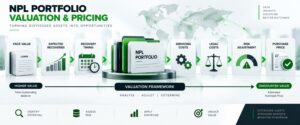
A simplified approach is:
Expected Recoveries − Servicing Costs − Legal Costs − Other Expenses = Expected Net Recoveries
The buyer then considers the timing of those recoveries, investment requirements, and the risks associated with the portfolio.
Face Value vs Purchase Price
The face value of an NPL portfolio represents the contractual amount owed or the relevant outstanding balance.
However, face value does not necessarily represent the amount a buyer will pay.
For example, a portfolio may have a high outstanding balance but limited recovery potential because of:
- Poor borrower information
- Low contactability
- Weak documentation
- Long delinquency periods
- Legal limitations
- Low collateral value
- High recovery costs
The purchase price therefore reflects the buyer’s assessment of future economic value rather than simply the outstanding debt.
Recovery Expectations
Historical collection performance is an important input into valuation.
Buyers may analyse:
- Gross collections
- Net collections
- Recovery rates
- Payment behaviour
- Settlement rates
- Legal recoveries
- Recovery timing
- Collection costs
Time Value of Money
The timing of recoveries also matters.
Recovering money sooner can have a different economic value from recovering the same amount several years later.
Valuation models may therefore use discounted cash-flow techniques to estimate the present value of expected future recoveries.
Secured vs Unsecured NPLs
Secured and unsecured portfolios require different valuation approaches.
For secured NPLs, buyers may assess:
- Collateral value
- Property or asset condition
- Existing charges
- Enforcement processes
- Expected realization period
For unsecured NPLs, valuation may depend more heavily on borrower data, contactability, payment history, collection performance, and legal enforceability.
NPL Due Diligence
Due diligence allows buyers to understand the quality and risks of a portfolio before completing a transaction.

Data Due Diligence
Buyers review the accuracy and completeness of the portfolio data.
They may check:
- Account balances
- Account status
- Payment history
- Duplicate records
- Missing information
- Delinquency dates
- Borrower information
Legal Due Diligence
Legal review can examine:
- Loan agreements
- Assignment rights
- Security documentation
- Existing litigation
- Insolvency proceedings
- Limitation periods
- Enforceability
- Regulatory requirements
Financial Due Diligence
Financial analysis focuses on the portfolio’s historical and expected cash flows.
This may include:
- Historical collections
- Outstanding balances
- Recovery rates
- Interest
- Fees
- Collection costs
- Expected future recoveries
Operational Due Diligence
The buyer also needs to understand how the portfolio can be serviced after acquisition.
Questions may include:
- Who will service the accounts?
- What technology is available?
- What collection channels can be used?
- What reporting will be provided?
- What legal resources are available?
- What customer communication processes are required?
Risks and Considerations
NPL transactions involve several risks that buyers and sellers need to understand.
Recovery Risk
Actual recoveries may be lower than the buyer’s original projections.
Borrower circumstances can change, and historical performance does not guarantee future results.
Data Risk
Incomplete or inaccurate portfolio data can affect valuation and recovery forecasts.
Strong data validation before a transaction can help reduce uncertainty.
Legal Risk
The enforceability of debt can vary between accounts and jurisdictions.
Loan documentation, assignment requirements, limitation periods, court procedures, and insolvency rules may all affect recovery.
Servicing Risk
The performance of the selected servicer can influence actual portfolio recoveries.
A portfolio may have reasonable underlying recovery potential but perform differently if the servicing strategy is ineffective or operational execution is weak.
Regulatory Risk
Debt sales and recovery activities can be subject to consumer protection, privacy, financial services, debt collection, and other regulatory requirements.
Requirements vary by jurisdiction and asset class.
Economic Risk
Economic conditions can influence borrower repayment capacity.
Factors such as unemployment, inflation, interest rates, property prices, and business conditions can affect future recoveries.
Timing Risk
NPL recoveries can take longer than expected, particularly when legal processes or complex borrower circumstances are involved.
Buyers should therefore consider multiple recovery scenarios rather than relying on a single forecast.
NPL Market Trends
The NPL market continues to evolve alongside changes in lending, economic conditions, regulation, technology, and investor demand.
Increased Focus on Portfolio Data
Data quality is becoming increasingly important in NPL transactions.
Sellers with structured and reliable portfolio information can provide buyers with a clearer basis for due diligence and valuation.
Growth of Digital Collections
Digital communication and payment channels are increasingly being incorporated into recovery strategies.
These can include:
- SMS
- Online payment portals
- Mobile applications
- Messaging platforms
- Self-service platforms
Use of AI and Analytics
Artificial intelligence, machine learning, and advanced analytics are increasingly being used to analyse portfolios and support servicing strategies.
Potential applications include:
- Customer segmentation
- Contact strategy
- Payment propensity modelling
- Recovery forecasting
- Collection prioritization
- Communication timing
Greater Portfolio Specialization
NPL portfolios are increasingly being evaluated based on specific characteristics rather than as a single category of distressed debt.
Buyers may focus on particular:
- Asset classes
- Geographic markets
- Loan types
- Delinquency stages
- Borrower segments
Changing Regulatory Requirements
Regulation remains an important factor in the NPL market.
Changes relating to debt sales, consumer protection, data privacy, debt collection, insolvency, and financial services can influence how transactions are structured and serviced.
NPL Market Lifecycle
The NPL market can be understood as a complete lifecycle rather than simply a debt-sale transaction.
- Credit Origination
A lender provides credit to a consumer or business.
- Delinquency
The borrower fails to make payments according to the agreed terms.
- Non-Performing Status
The exposure meets the applicable criteria for classification as non-performing.
- Portfolio Management
The lender evaluates recovery, restructuring, servicing, and potential disposal options.
- Portfolio Sale
The NPL portfolio is offered to qualified buyers.
- Acquisition
The selected buyer completes the transaction and acquires the relevant rights and economic exposure.
- Servicing
The buyer or appointed servicer manages the portfolio.
- Recovery
Collections, settlements, restructuring, legal recovery, or collateral realization may be used depending on the portfolio.
- Portfolio Resolution
Accounts are resolved through repayment, settlement, legal recovery, asset realization, or other applicable outcomes.
NPL Portfolio Management
Purchasing a portfolio is only the beginning of the NPL investment lifecycle.
Once the transaction is complete, buyers need to monitor portfolio performance against the assumptions used during valuation.
Important performance indicators may include:
- Gross collections
- Net collections
- Recovery rate
- Collection efficiency
- Cost-to-collect
- Cash collected versus forecast
- Average recovery per account
- Settlement performance
- Payment-plan performance
- Legal recovery performance
Regular portfolio reporting allows buyers and servicers to identify differences between expected and actual performance.
Portfolio segmentation can also support more targeted recovery strategies.
Accounts can be segmented based on:
- Balance
- Delinquency age
- Loan type
- Geography
- Contactability
- Payment history
- Legal status
- Collateral
- Previous recovery activity
This allows different groups of accounts to be managed according to their characteristics rather than applying the same strategy across the entire portfolio.