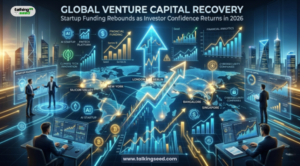
After two years of tightened capital flows and cautious investor sentiment, global venture capital funding is showing clear signs of recovery in 2025. Fresh quarterly data from leading market intelligence platforms indicates that deal activity is accelerating, valuations are stabilizing, and capital is increasingly concentrating around artificial intelligence, deep tech, and infrastructure-driven innovation.
While the rebound is uneven across regions and sectors, the overall direction is unmistakable: venture investors are back in the market, deploying capital with renewed conviction—but under a more disciplined, data-driven framework than during the pre-2022 boom.
A Measured Comeback After the Funding Reset
The global VC market entered 2025 carrying the scars of an extended correction. Rising interest rates, liquidity tightening, and weaker exit markets had reshaped investor behavior between 2022 and 2024. Mega-rounds declined, down rounds became common, and early-stage founders faced higher scrutiny on unit economics and execution.
In 2025, that reset is translating into a healthier funding environment. Investors are no longer chasing growth at any cost. Instead, capital is flowing toward companies demonstrating real technological differentiation, scalable revenue models, and defensible market positions.
Rather than a speculative rebound, the current upswing reflects a recalibration of risk and return expectations.

AI Becomes the Primary Engine of Deal Volume
Artificial intelligence has emerged as the dominant force behind the VC funding recovery. Across early-stage, growth-stage, and late-stage deals, AI-driven startups are accounting for a growing share of both deal count and total capital deployed.
The focus has shifted beyond generic AI applications toward specialized use cases, including:
- Enterprise AI platforms are improving productivity and automation
- Vertical-specific AI solutions in healthcare, finance, logistics, and legal services
- Foundation models and compute optimization technologies
- AI infrastructure, chips, and data-layer innovations
Investors are increasingly prioritizing companies with proprietary data access, clear monetization paths, and regulatory awareness. The narrative has moved away from hype-driven experimentation toward applied intelligence with measurable business outcomes.
This evolution is reinforcing AI’s role not just as a sector, but as a foundational layer reshaping multiple industries simultaneously.
Deep Tech Regains Investor Confidence
Alongside AI, deep tech is staging a significant comeback in 2025. Technologies once considered capital-intensive and long-dated are attracting renewed interest as governments, corporates, and institutional investors align around long-term strategic priorities.
Key areas drawing sustained VC attention include:
- Semiconductor innovation and advanced manufacturing
- Climate and energy transition technologies
- Robotics and automation
- Space and defense-adjacent technologies
- Quantum computing and advanced materials
What distinguishes the current deep tech cycle is stronger public-private collaboration. Sovereign funds, national development agencies, and corporate venture arms are increasingly co-investing with traditional VC firms, helping bridge funding gaps and de-risk commercialization timelines.
This structural support is making deep tech investments more viable and attractive in a higher-rate environment.

United States: Funding Rebounds, but Discipline Remains
The United States continues to lead global venture capital deployment in 2025, though the nature of funding has changed. Silicon Valley, New York, and emerging hubs like Austin and Miami are seeing increased deal flow, particularly in AI and enterprise software.
However, investors remain selective. Founders are expected to demonstrate:
- Clear revenue traction or enterprise adoption
- Capital efficiency and extended runway planning
- Reduced dependence on follow-on mega-rounds
Late-stage funding is returning, but valuations are more grounded than during the previous cycle. Many companies that delayed fundraising in 2023 and 2024 are now re-entering the market with restructured cost bases and clearer paths to profitability.
Exit expectations are also evolving, with more realistic IPO timelines and greater openness to strategic acquisitions.
Europe: Steady Growth Driven by Regulation-Ready Innovation
European venture capital activity is gaining momentum in 2025, supported by stronger policy alignment, cross-border investment frameworks, and growing interest in regulation-compliant innovation.
AI and deep tech startups in the EU are benefiting from:
- Emphasis on ethical AI and data protection compliance
- Public funding programs supporting research commercialization
- Strong talent pipelines from academic and industrial ecosystems
Germany, France, the UK, and the Nordics remain core VC hubs, while Southern and Eastern Europe are increasingly attracting early-stage capital due to lower operating costs and improving startup infrastructure.
European investors are particularly focused on B2B platforms, industrial technology, fintech infrastructure, and climate solutions that align with long-term regulatory and sustainability mandates.
GCC and Middle East: Capital Strength Meets Innovation Demand
The GCC region is playing an increasingly influential role in the 2025 VC recovery. Sovereign wealth funds, family offices, and regional investment platforms are deploying capital both domestically and internationally.
Key characteristics of the Middle East VC landscape include:
- Strong appetite for AI, fintech, and digital infrastructure
- Strategic alignment with national diversification agendas
- Willingness to fund later-stage and scale-up rounds
The UAE and Saudi Arabia are emerging as regional venture hubs, supported by regulatory reforms, startup-friendly policies, and growing talent inflows. Cross-border investment between the GCC, Europe, and Asia is also accelerating, positioning the region as a global capital connector rather than a purely local market.
This influx of patient, long-term capital is helping stabilize funding cycles and support ambitious technology-driven ventures.
Deal Sizes Normalize as Portfolio Strategies Shift
One of the most notable trends in 2025 is the normalization of deal sizes. Instead of oversized rounds driven by competitive pressure, investors are structuring funding to align closely with operational milestones.
This approach reflects a broader portfolio strategy shift:
- More capital allocated to fewer, higher-conviction bets
- Increased use of tranched funding and milestone-based releases
- Greater emphasis on follow-on protection for existing portfolio companies
For founders, this means clearer expectations but less tolerance for inefficiency. The era of unchecked burn rates has given way to disciplined growth planning.
Corporate Venture Capital Re-Engages
Corporate venture capital arms, which pulled back during the downturn, are re-entering the market in 2025 with a sharper strategic lens. Rather than acting as passive financial investors, corporates are targeting startups that complement their long-term innovation roadmaps.
This is especially visible in:
- AI tools enhancing internal operations
- Deep tech aligned with supply chain resilience
- Energy and climate technologies supporting decarbonization goals
CVC participation is adding depth to the funding ecosystem and creating alternative exit pathways for startups outside traditional IPO routes.
Founder Expectations Reset, Execution Takes Center Stage
The rebound in VC funding does not signal a return to founder-friendly excess. Instead, it reflects a mature market where execution quality outweighs narrative appeal.
Founders raising capital in 2025 are expected to demonstrate:
- Real customer adoption and retention
- Defensible technology or market position
- Strong governance and financial controls
This shift is reshaping startup culture, encouraging sustainable scaling over rapid expansion and reinforcing long-term value creation.

Outlook: A Smarter, More Resilient VC Market
The global venture capital rebound in 2025 is less about volume and more about quality. AI and deep tech are leading the recovery not because they are fashionable, but because they address fundamental economic and operational challenges.
As regional ecosystems mature and capital becomes more strategically aligned, the VC market is evolving into a more resilient and disciplined engine of innovation. While volatility remains a constant, the current funding cycle suggests that venture capital has emerged from its correction phase stronger, smarter, and better prepared for long-term growth.