
Receivables are a fundamental component of the credit and debt markets. They represent amounts owed to a business, lender, financial institution, or other creditor and can arise from commercial transactions, consumer lending, credit facilities, invoices, and other contractual obligations.
For an originating business, a receivable represents an expected future payment. For a lender, investor or debt buyer, the same receivable can become a financial asset that can be managed, valued, financed, transferred or sold.
This makes receivables particularly relevant to the secondary debt market.
A receivables portfolio may contain hundreds, thousands or even millions of individual accounts. Each account can have different balances, payment histories, contractual terms, delinquency stages, documentation and recovery expectations. As a result, the value of a portfolio cannot be determined simply by adding the amounts outstanding.
A proper assessment considers the quality of the underlying accounts, expected cash flows, payment timing, servicing costs, recovery prospects, legal position and portfolio-level risks.
The receivables lifecycle can therefore be viewed as:
Origination → Outstanding Receivable → Payment → Monitoring → Collection → Valuation → Sale or Transfer → Servicing → Recovery
Understanding this lifecycle is important for lenders, businesses, investors, debt buyers, servicers and other participants involved in the buying and selling of debt portfolios.
What Are Receivables?
A receivable is an amount that an individual, business or organisation has the right to receive from another party.
The obligation may arise because goods or services were provided, credit was extended, or another contractual payment obligation was created.
Common examples include:
- Trade invoices
- Consumer loans
- Credit card balances
- Commercial loans
- Utility accounts
- Telecommunications accounts
- Healthcare receivables
- Lease receivables
- Retail finance
- Marketplace receivables
The underlying receivable can be current, overdue, delinquent, defaulted or undergoing recovery.
Receivables as Financial Assets
A receivable can change its role during its lifecycle.
Initially, it may simply be an amount owed to the original creditor. Once aggregated with similar accounts, it can become part of a receivables portfolio.
That portfolio can then be:
- Retained by the originator
- Financed
- Securitised
- Restructured
- Serviced by a specialist provider
- Sold to another investor
- Transferred to a debt purchaser
This creates an important connection between the primary credit market and the secondary debt market.
Types of Receivables
Receivables vary significantly depending on their origin, debtor type and contractual structure.
Trade Receivables
Trade receivables arise when a business provides goods or services and allows the customer to pay at a later date.
The basic relationship is:
Goods or Services → Invoice → Receivable → Customer Payment
Trade receivables are often short-term, although payment periods vary by industry and agreement.
The quality of a trade receivables portfolio can depend on customer concentration, payment behaviour, invoice disputes and the financial strength of the underlying customers.
Consumer Receivables
Consumer receivables represent amounts owed by individuals.
Examples include:
- Personal loans
- Credit card balances
- Retail finance
- Telecommunications accounts
- Utility accounts
- Consumer finance
- Buy-now-pay-later balances
These portfolios can contain a large number of relatively small individual accounts, making data quality, segmentation and servicing particularly important.
Commercial Receivables
Commercial receivables are amounts owed by businesses.
They may involve larger balances and more complex contracts than consumer receivables.
Assessment can include:
- Customer financial strength
- Contract terms
- Payment history
- Concentration
- Commercial disputes
- Security
- Counterparty risk
Loan Receivables
Loan receivables represent amounts due under a credit agreement.
They may include outstanding principal, interest, fees and other contractual amounts.
Loan receivables can subsequently be refinanced, restructured, transferred or sold as individual assets or as part of a larger portfolio.
The Receivables Lifecycle
Receivables should be viewed as assets moving through a defined lifecycle rather than simply as outstanding balances.
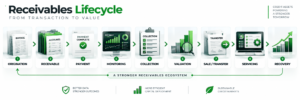
- Origination
A commercial transaction or credit arrangement creates the payment obligation.
- Billing or Funding
The amount becomes payable according to the applicable invoice, contract or loan agreement.
- Payment Monitoring
The creditor monitors whether payments are received according to agreed terms.
- Delinquency
If payment is missed, the account may move into an overdue or delinquent status.
- Collection
The creditor or appointed servicer begins appropriate collection activity.
- Recovery
Accounts that remain unresolved may move into more advanced recovery processes.
- Valuation
The creditor or potential buyer assesses the economic value of the receivable or portfolio.
- Sale or Transfer
The receivable may be sold or transferred, subject to contractual, legal and regulatory requirements.
- Ongoing Servicing
The accounts continue to require payment administration, customer communication, reporting and recovery management.
This lifecycle creates multiple points at which data, servicing quality and portfolio performance can influence value.
Receivables Portfolio Management
Managing one receivable is relatively straightforward. Managing a portfolio containing thousands of accounts requires a structured approach.
Portfolio managers commonly segment receivables according to:
- Outstanding balance
- Payment status
- Account age
- Product type
- Customer type
- Geography
- Payment history
- Delinquency stage
- Legal status
- Recovery status
Segmentation helps managers identify different performance patterns and apply appropriate strategies.
For example, current accounts may require routine monitoring, while older delinquent accounts may require more intensive collection or recovery activity.
Portfolio management therefore combines data, analysis, servicing and strategy.
Performing and Non-Performing Receivables
The payment status of an account has a direct relationship with how it may be managed and valued.
Performing Receivables
Performing receivables are generally paying according to their expected schedule.
Their future cash flows may be relatively predictable, although they remain subject to credit and payment risk.
Non-Performing Receivables
Non-performing receivables have experienced significant payment problems and may require additional collection, restructuring or recovery activity.
For these accounts, valuation may depend more heavily on:
- Expected recovery
- Recovery timing
- Collection costs
- Legal costs
- Documentation
- Debtor circumstances
- Servicing capability
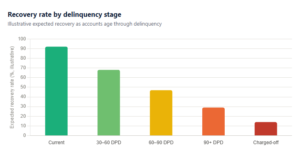
This distinction becomes particularly important when receivables are being prepared for sale.
Receivables Data and Portfolio Quality
Data is one of the most important assets in a receivables portfolio transaction.
A buyer needs sufficient information to understand what is being purchased and to estimate future cash flows.
Typical portfolio information can include:
Data Area | Examples |
|---|---|
Account | Account status, product, reference |
Balance | Principal, interest, fees, outstanding amount |
Payment | Dates, amounts, payment history |
Delinquency | Days past due, current status |
Contract | Agreement, maturity, terms |
Collection | Actions, arrangements, outcomes |
Legal | Disputes, proceedings, documentation |
Recovery | Recoveries, costs, timelines |
Servicing | Current provider and activity |
Before a portfolio is marketed to potential buyers, data may need to be cleaned, reconciled, standardised and validated.
Inconsistent balances, duplicate accounts, missing payment histories or incomplete documentation can make due diligence more difficult and may affect buyer confidence.
Receivables Valuation
The face value of a receivables portfolio is not necessarily its market value.
A portfolio with a high outstanding balance may have a substantially different economic value depending on the expected amount and timing of future collections.
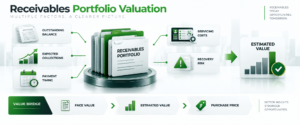
A simplified valuation framework is:
Outstanding Balance → Expected Collections → Timing → Costs → Risk → Estimated Value
Outstanding Balance
The outstanding balance provides the starting point for analysis.
Expected Collections
The buyer estimates how much of the balance may ultimately be collected.
Recovery Timing
The expected timing of future collections affects their economic value.
Servicing Costs
Collection and portfolio management costs reduce the net cash available to the owner.
Legal and Recovery Costs
Accounts requiring legal or specialist recovery activity may involve additional costs.
Risk
Uncertainty around payment behaviour, documentation, enforceability and recovery can influence the valuation.
The result is an assessment based on expected economic cash flows, rather than simply the gross amount owed.
Receivables Portfolio Pricing
Pricing a receivables portfolio requires analysis of both its current condition and expected future performance.
Factors can include:
- Portfolio balance
- Payment history
- Delinquency profile
- Account age
- Historical collections
- Recovery performance
- Expected future collections
- Recovery timing
- Documentation
- Legal position
- Servicing costs
- Collection strategy
- Transfer requirements
- Market conditions
Two portfolios with identical face values can therefore have very different transaction values.
Face Value vs Purchase Price
This distinction is fundamental to debt portfolio transactions.
Face Value is the amount recorded as outstanding.
Purchase Price is the amount a buyer is prepared to pay for the portfolio based on its expected cash flows, risks, costs and other transaction considerations.
The difference reflects factors such as uncertainty, timing, expected recoveries and the cost of managing the assets.
Receivables Due Diligence
Due diligence allows a potential buyer to understand the portfolio before committing to a transaction.
A comprehensive review can be divided into four major areas.
Data Due Diligence
The buyer may examine:
- Data completeness
- Balance accuracy
- Duplicate records
- Payment history
- Account status
- Portfolio reconciliation
- Historical performance
Legal Due Diligence
Legal review may consider:
- Underlying agreements
- Ownership
- Assignment rights
- Security
- Transfer restrictions
- Enforcement rights
- Disputes
- Regulatory requirements
Financial Due Diligence
Financial analysis can focus on:
- Outstanding balances
- Historical collections
- Recovery rates
- Delinquency movement
- Expected cash flows
- Collection costs
Operational Due Diligence
Operational analysis may examine:
- Current servicing arrangements
- Collection processes
- Technology
- Reporting
- Customer communication
- Compliance controls
- Recovery capabilities
The objective is to understand not only what the portfolio contains, but also how it is likely to perform under future ownership.
Buying and Selling Receivables
Receivables can become transferable financial assets when an original creditor decides to sell or transfer them.
A typical transaction may follow:
Portfolio Identification → Data Preparation → Buyer Outreach → Due Diligence → Valuation → Bidding → Negotiation → Transfer → Servicing → Recovery
Portfolio Identification
The seller identifies a group of receivables suitable for a potential transaction.
Data Preparation
Account-level information and supporting documentation are organised.
Buyer Identification
Potential buyers are identified according to portfolio type, investment strategy and acquisition criteria.
Due Diligence
Interested buyers review the portfolio data and relevant documentation.
Valuation
Buyers assess expected cash flows, recovery prospects, risks and costs.
Negotiation
The parties negotiate price and transaction terms.
Transfer
Ownership or relevant rights are transferred according to the transaction structure.
Servicing
The accounts continue to be managed by the existing servicer or a new provider.
This process allows existing credit assets to move from one owner to another while maintaining the operational infrastructure required to manage them.
Receivables in the Secondary Debt Market
The secondary debt market provides a mechanism for existing receivables to change ownership.
For sellers, portfolio sales can support objectives such as:
- Balance-sheet management
- Portfolio rebalancing
- Liquidity management
- Risk management
- Strategic focus
- Disposal of non-core assets
For buyers, receivables portfolios can provide access to existing credit exposures without originating every account themselves.

Potential participants can include:
- Banks
- Finance companies
- Consumer lenders
- Commercial businesses
- Debt purchasers
- Investment funds
- Institutional investors
- Specialist finance companies
- Servicers
The attractiveness of a portfolio depends on its composition, data quality, expected performance, legal position and servicing requirements.
Receivables Servicing
Servicing is the operational foundation of a receivables portfolio.
A servicer may manage:
- Payment processing
- Account administration
- Customer communication
- Collections
- Payment arrangements
- Reconciliation
- Reporting
- Compliance processes
- Recovery activity
Servicing also generates valuable portfolio data.
Payment history, collection outcomes and recovery performance can provide important information for future valuation and portfolio management.
When a portfolio changes ownership, the servicing arrangement therefore becomes an important part of the transaction.
Receivables and Recovery
When accounts become delinquent, recovery strategy becomes increasingly important.
A typical progression may be:
Reminder → Customer Engagement → Payment Arrangement → Collections → Escalation → Legal Recovery → Resolution
Not every account follows the same path.
Portfolio segmentation can help determine the appropriate strategy based on factors such as:
- Account age
- Balance
- Payment history
- Previous collection activity
- Documentation
- Legal status
- Recovery potential
The objective is to align servicing and recovery activity with the characteristics of the underlying portfolio.
Technology and Receivables Management
Technology increasingly supports the management and trading of receivables.
Digital platforms can support:
- Account-level data management
- Portfolio segmentation
- Payment tracking
- Collection workflows
- Customer communication
- Performance reporting
- Portfolio valuation
- Buyer due diligence
- Portfolio transfer
- Recovery analytics
For large portfolios, technology can also make it easier to identify trends across thousands of accounts.
Structured data allows buyers to analyse portfolio performance more efficiently and helps sellers prepare assets for potential transactions.
The result is a more connected receivables ecosystem:
Data → Analysis → Servicing → Valuation → Transaction → Recovery
Receivables Risk Factors
Receivables involve several forms of risk.
Credit Risk
The debtor may fail to pay the amount owed.
Concentration Risk
A portfolio may be heavily dependent on a small number of customers or debtors.
Documentation Risk
Missing or incomplete agreements may affect enforceability or transferability.
Legal Risk
Disputes, regulatory requirements and jurisdictional differences may affect recoverability.
Servicing Risk
Weak collection or account-management processes can affect portfolio performance.
Data Risk
Incorrect balances, duplicate records or incomplete payment histories can influence valuation.
Timing Risk
Recoveries may occur later than expected, affecting the economic value of the portfolio.
Effective portfolio management therefore requires continuous monitoring rather than relying solely on the original valuation.
Receivables Portfolio Performance
Once a portfolio has been originated or acquired, performance needs to be measured against expectations.
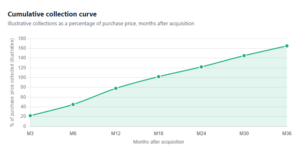
Important indicators can include:
- Collection performance
- Recovery performance
- Payment rates
- Delinquency movement
- Resolution rates
- Cost to collect
- Servicing performance
- Cash-flow timing
Performance data can be used to update valuation assumptions and identify changes in portfolio quality.
For buyers, actual performance following acquisition can also provide insight into future portfolio strategy and potential exit opportunities.
Receivables and Portfolio Financing
Receivables can also support financing arrangements.
A business may seek funding against eligible receivables rather than waiting for customers to pay.
Depending on the structure, this can include:
- Factoring
- Receivables-backed lending
- Asset-based lending
- Structured finance
- Securitisation
This demonstrates that receivables can serve several functions within the financial system.
They can be:
Operating Assets → Financing Assets → Investment Assets → Tradable Debt Assets
The appropriate structure depends on the characteristics of the receivables, the parties involved and the applicable legal and regulatory framework.
Receivables and Securitisation
Large pools of receivables can potentially be used in securitisation structures.
A simplified structure is:
Receivables Pool → Special-Purpose Vehicle → Securities → Investors
The underlying receivables generate cash flows that support payments to investors according to the transaction structure.
Securitisation can therefore create another pathway through which receivables move from an originator into an investment structure.
As with a portfolio sale, the quality of the underlying receivables, documentation, servicing arrangements and expected cash flows are critical to the transaction.
What Makes a Receivables Portfolio Suitable for Sale?
There is no single characteristic that determines whether a portfolio is suitable for a transaction.
Potential buyers may examine:
Portfolio Composition
What types of receivables are included?
Data Quality
Is the account-level information complete, accurate and consistent?
Payment Performance
How have the accounts performed historically?
Documentation
Are the relevant agreements and supporting documents available?
Recovery History
What has historically been collected from comparable accounts?
Servicing
Who manages the portfolio and what infrastructure is available?
Legal Position
Are the receivables transferable and enforceable under the applicable framework?
Expected Cash Flow
What collections might reasonably be expected, and over what timeframe?
These factors provide the foundation for portfolio due diligence and pricing.