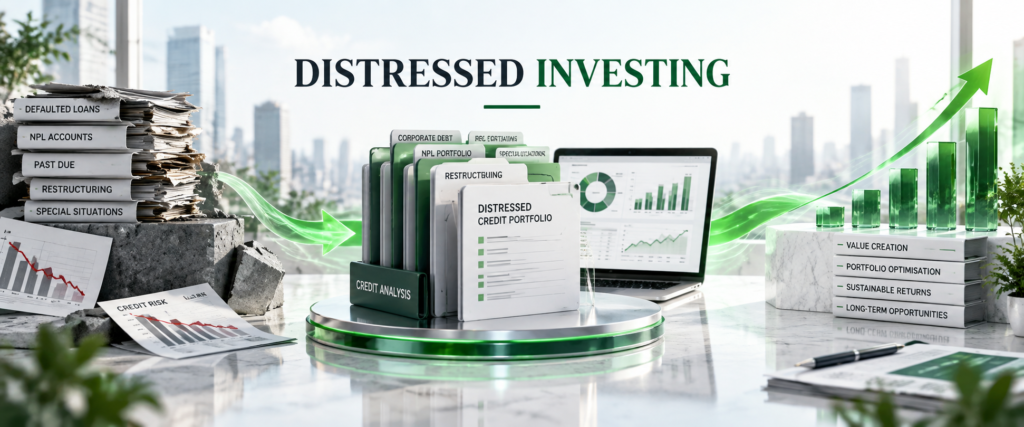
Distressed investing focuses on acquiring and managing investments where financial stress, credit deterioration, restructuring, default or other circumstances have created a significant difference between an asset’s current condition and its potential economic value.
Unlike conventional investing, where investors often focus on stable earnings, predictable cash flows and long-term growth, distressed investing requires a detailed assessment of downside risk, recovery potential, capital structure, documentation, liquidity and the path to resolution.
Distressed assets can include non-performing loans (NPLs), distressed debt, defaulted loans, stressed credit portfolios, corporate debt, distressed receivables and other credit-related assets.
The opportunity often emerges when an asset is being sold below its original or contractual value. However, the discount itself does not determine whether an investment opportunity exists. Investors need to establish what can realistically be recovered, how long recovery may take, what additional capital may be required and what risks could affect the outcome.
A simplified distressed investing framework is:
Identify → Analyse → Due Diligence → Value → Acquire → Manage → Restructure / Recover → Realise Value
This makes distressed investing closely connected to the secondary debt market, private credit, portfolio sales, debt servicing, NPL investing and debt recovery.
What Is Distressed Investing?
Distressed investing is the practice of investing in financial assets, companies or credit exposures experiencing financial difficulty or trading under conditions associated with financial distress.
The investment may involve purchasing an asset directly, acquiring debt in the secondary market, participating in a restructuring, providing capital to a financially stressed business or purchasing a portfolio of distressed credit assets.

Common characteristics can include:
- Payment defaults
- Significant delinquency
- Deteriorating credit quality
- Liquidity pressure
- Restructuring
- Covenant breaches
- Insolvency proceedings
- Reduced asset values
- Forced or strategic portfolio sales
Distressed investing can therefore involve both credit analysis and recovery analysis.
The investor is not simply asking whether a borrower can make its next payment. The analysis may extend to:
What is the asset worth today?
What could be recovered?
What is the likely recovery timeline?
What costs will be incurred?
What happens under different downside scenarios?
These questions are central to distressed debt investing and distressed credit portfolio analysis.
Distressed Debt vs. Performing Credit
The distinction between performing and distressed credit is important.
Performing Credit
A performing credit asset generally continues to meet its contractual payment obligations.
Analysis may focus on:
- Credit quality
- Interest income
- Cash-flow stability
- Maturity
- Borrower financial strength
- Default probability
Distressed Credit
A distressed credit asset may have experienced significant deterioration.
Analysis can focus more heavily on:
- Recovery value
- Collateral
- Legal rights
- Restructuring
- Default probability
- Servicing
- Recovery timing
- Exit scenarios
The transition from performing to distressed can change the way an asset is valued.
For example, the analysis may shift from expected contractual cash flows toward risk-adjusted recovery cash flows.
Why Distressed Assets Enter the Market
Distressed assets can enter the secondary market for several reasons.
Credit Deterioration
A lender may decide to sell assets after borrowers experience sustained payment problems.
Balance-Sheet Management
Financial institutions may sell certain credit exposures as part of broader portfolio management.
Risk Reduction
A portfolio owner may seek to reduce exposure to particular sectors, products, borrowers or geographic markets.
Liquidity Requirements
A seller may seek to convert credit assets into liquidity rather than continue holding them.
Portfolio Repositioning
Investment managers and lenders periodically review their portfolios and may dispose of assets that no longer fit their strategy.
Restructuring
Corporate or credit restructuring can create opportunities for investors to acquire debt at revised valuations.
These situations can create a secondary market where distressed debt buyers evaluate assets based on potential future recovery rather than simply their original face value.
Major Distressed Investing Strategies
Distressed investing is not one single strategy. Different investors approach distressed assets according to their capital structure, risk tolerance, investment horizon and expertise.
Distressed Debt Investing
An investor purchases debt trading below its face or expected contractual value.
The investment thesis may depend on future repayments, restructuring, asset recovery or a combination of outcomes.
Non-Performing Loan Investing
Investors acquire non-performing loans (NPLs) from lenders or other portfolio owners.
The focus can include:
- Historical collections
- Expected recoveries
- Servicing
- Legal position
- Recovery timing
- Portfolio segmentation
Special Situations Investing
Special situations investors may target complex situations where a corporate event, restructuring, refinancing or asset sale creates an investment opportunity.
Loan-to-Own Strategies
In certain situations, an investor may acquire debt with the objective of gaining influence over a restructuring or ultimately obtaining ownership of an underlying business or asset.
The legal and transaction structure varies significantly by jurisdiction and situation.
Distressed Credit Portfolio Acquisition
Rather than purchasing individual loans, investors may acquire a portfolio containing hundreds or thousands of distressed accounts.
This requires portfolio-level analysis as well as account-level due diligence.
Distressed Investing in the Secondary Debt Market
The secondary debt market provides an important mechanism for distressed assets to change ownership.
A simplified transaction may look like:
Originator → Credit Portfolio → Portfolio Sale → Distressed Debt Buyer → Servicer → Recovery
The original lender may no longer want to retain the exposure.
A distressed debt investor may acquire the portfolio at a price reflecting its assessment of expected future cash flows and risks.
After acquisition, the investor may work with a servicer to manage collections, restructuring, recovery and reporting.
This creates a connection between:
Debt Purchase → Distressed Investing → Debt Servicing → Recovery
The secondary market therefore allows different participants to apply different investment and servicing strategies to the same underlying credit assets.
Distressed Asset Valuation
Valuation is one of the most important parts of distressed investing.
The face value of distressed debt does not necessarily represent its economic value.

A simplified framework is:
Face Value → Expected Recovery → Recovery Timing → Costs → Risk Adjustment → Estimated Value
Face Value
The contractual amount outstanding.
Expected Recovery
The amount the investor estimates could ultimately be collected or realised.
Recovery Timing
The period required to generate those recoveries.
Costs
Potential servicing, legal, restructuring and recovery expenses.
Risk Adjustment
Uncertainty surrounding the expected outcome.
Estimated Value
The investor’s assessment of the asset’s economic value under the relevant assumptions.
The purchase price is then considered in relation to the investor’s investment objectives, assumptions and required economics.
Distressed Investing Due Diligence
Due diligence is particularly important when acquiring distressed assets because the investor may face greater uncertainty around cash flows and recovery outcomes.
Financial Due Diligence
Investors may review:
- Outstanding balances
- Payment history
- Borrower financial information
- Historical collections
- Recovery performance
- Cash-flow expectations
Legal Due Diligence
Legal review can include:
- Loan agreements
- Assignment rights
- Security
- Guarantees
- Enforcement rights
- Litigation
- Bankruptcy or insolvency proceedings
Portfolio Data Due Diligence
For large portfolios, investors may analyse:
- Account-level records
- Delinquency status
- Geographic distribution
- Product type
- Balance distribution
- Payment behaviour
- Collection history
Operational Due Diligence
This can include assessment of:
- Current servicer
- Collection processes
- Technology
- Reporting
- Recovery infrastructure
- Servicing costs
A distressed investment is therefore often only as reliable as the information supporting its valuation.
The Role of Recovery in Distressed Investing
Recovery analysis is central to distressed credit investing.
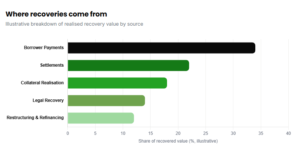
Investors may consider multiple potential recovery sources depending on the asset.
These can include:
- Borrower payments
- Restructuring
- Settlements
- Collateral realisation
- Asset sales
- Legal recovery
- Refinancing
- Business restructuring
Recovery expectations should be connected to realistic assumptions about timing and cost.
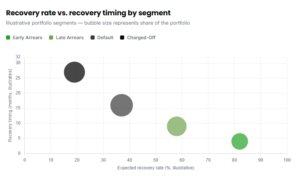
For example, a recovery that appears attractive in nominal terms may have a different economic value if it requires a long legal or restructuring process.
This is why recovery timing can be as important as the expected recovery amount.
Distressed Debt and Servicing
Servicing becomes particularly important after a distressed debt acquisition.
A servicer may manage:
- Account administration
- Customer communication
- Collections
- Payment arrangements
- Recovery
- Legal escalation
- Reporting
- Reconciliation
The investor depends on accurate servicing information to understand how the portfolio is performing.
The relationship can be represented as:
Investor → Portfolio Owner → Servicer → Account Management → Recovery
Effective servicing creates the operational connection between the investment thesis and actual portfolio performance.
Portfolio-Level Distressed Investing
Large distressed portfolios require a different analytical approach from individual distressed assets.
An investor may need to analyse thousands of accounts simultaneously.
Portfolio segmentation can help identify differences in:
- Delinquency
- Balance
- Geography
- Product
- Customer type
- Recovery history
- Legal status
- Servicing requirements
For example, a portfolio may contain:
Current → Early Arrears → Late Arrears → Default → Charged-Off
Each segment can have different expected recovery characteristics.
Portfolio-level analysis allows investors to assess the overall composition while still retaining account-level visibility.
Distressed Investing and Portfolio Sales
Portfolio sales are an important source of opportunities for distressed investors.
A typical distressed portfolio sale can involve:
Portfolio Identification → Data Preparation → Buyer Outreach → Due Diligence → Valuation → Bidding → Negotiation → Transfer → Servicing
The buyer may receive access to a data room containing portfolio information and supporting documentation.
Potential buyers then develop their own valuation models and submit bids.
The seller may consider several transaction terms, while the buyer focuses on the expected economics of the acquired portfolio.
This process connects portfolio sales directly with the distressed investing market.
Distressed Investing Risk Factors
Distressed investing can involve several layers of uncertainty.
Recovery Risk
Actual recoveries may differ from expectations.
Timing Risk
Recoveries may take longer than initially projected.
Legal Risk
Enforcement, ownership, documentation or jurisdictional issues may affect recovery.
Servicing Risk
Poor servicing performance can affect collections and portfolio outcomes.
Valuation Risk
The assumptions used to estimate value may prove inaccurate.
Liquidity Risk
Distressed assets may be difficult to sell quickly at an acceptable price.
Concentration Risk
Exposure to a particular borrower, sector, product or geography can increase portfolio sensitivity.
Data Risk
Incomplete or inaccurate portfolio information can affect investment analysis.
A comprehensive distressed investment process therefore needs to evaluate both potential value and potential downside.
Distressed Investing and Risk-Adjusted Returns
Distressed investors generally analyse more than the discount between face value and purchase price.
A simplified example of the analytical relationship is:
Purchase Price + Costs → Expected Recoveries → Timing → Risk-Adjusted Outcome
The purchase price alone does not determine the investment result.
Two portfolios with identical face values can have significantly different economic characteristics because of differences in:
- Recovery rates
- Servicing costs
- Legal complexity
- Account quality
- Recovery timing
- Documentation
- Portfolio composition
This is why distressed investment analysis needs to move beyond headline portfolio balances.
Distressed Investing and Private Credit
Private credit and distressed investing can overlap, although they are not identical strategies.
Private credit generally involves lending directly to businesses or other borrowers outside traditional public debt markets.
Distressed investing focuses on financial assets or situations experiencing significant stress or deterioration.
The relationship becomes particularly relevant when a private credit investment experiences:
- Payment difficulties
- Covenant issues
- Refinancing pressure
- Business deterioration
- Restructuring
A private credit investor may need to reassess the credit exposure, while a distressed investor may evaluate the resulting opportunity.
This creates a connection between private credit, distressed debt and special situations investing.
Technology in Distressed Investing
Technology has become increasingly important in analysing large distressed portfolios.
Digital platforms can support:
- Portfolio data processing
- Account segmentation
- Data validation
- Cash-flow analysis
- Recovery modelling
- Portfolio monitoring
- Servicing oversight
- Performance reporting
Analytics can help investors identify patterns across thousands of accounts that would be difficult to assess manually.
For example, investors can segment portfolios according to delinquency, payment history, balance, recovery performance and servicing outcomes.
Technology does not remove investment risk, but it can improve the organisation and analysis of portfolio information.
Distressed Investing Performance Monitoring
The investment process does not end at acquisition.
After purchasing distressed assets, investors may monitor actual performance against the assumptions used during underwriting.
Important indicators can include:
- Collections
- Recoveries
- Cash flows
- Recovery timing
- Servicing costs
- Legal costs
- Delinquency movement
- Resolution rates
A simple monitoring framework is:
Underwriting Assumptions → Acquisition → Servicing → Actual Performance → Valuation Review
If actual performance differs from the original assumptions, the investor may reassess the portfolio strategy and valuation.
How Investors Evaluate a Distressed Opportunity
A distressed investment analysis may bring together several questions:
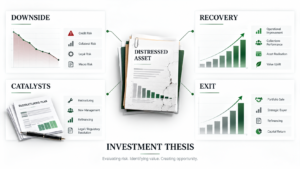
- What is being purchased?
Understand the underlying asset, contractual rights and portfolio composition.
- Why is the asset distressed?
Identify the source of financial stress or credit deterioration.
- What information is available?
Assess the quality and completeness of the portfolio data and documentation.
- What can realistically be recovered?
Develop recovery assumptions based on available evidence.
- How long could recovery take?
Consider the expected timing of cash flows.
- What costs will be incurred?
Include servicing, legal, restructuring and other relevant costs.
- What could change the outcome?
Identify legal, operational, market and borrower-specific risks.
- What is the appropriate purchase price?
Determine the price that aligns with the investor’s own valuation framework and investment objectives.
This framework helps distinguish an attractive-looking discount from a genuinely analysable investment opportunity.
Distressed Investing and Debt Recovery
Debt recovery is the operational outcome through which distressed credit investments can generate cash flows.
Recovery strategies can differ based on the asset.
For unsecured consumer debt, recovery may primarily involve account-level collection activity and payment arrangements.
For secured credit, recovery may involve collateral.
For corporate distressed debt, recovery can involve restructuring, refinancing, asset sales or changes in ownership.
The appropriate approach therefore depends on the structure of the underlying credit exposure.
Distressed Investing and the Credit Lifecycle
Distressed investing sits toward the later stages of the credit lifecycle, but it can also influence the earlier stages.
A simplified credit lifecycle is:
Origination → Performing → Delinquency → Default → Distress → Restructuring / Recovery → Resolution
At each stage, the characteristics of the credit asset can change.
For investors operating in the secondary market, these changes create different acquisition and portfolio-management opportunities.
This makes distressed investing closely connected with credit risk management, NPL markets, portfolio sales, debt servicing and recovery management.