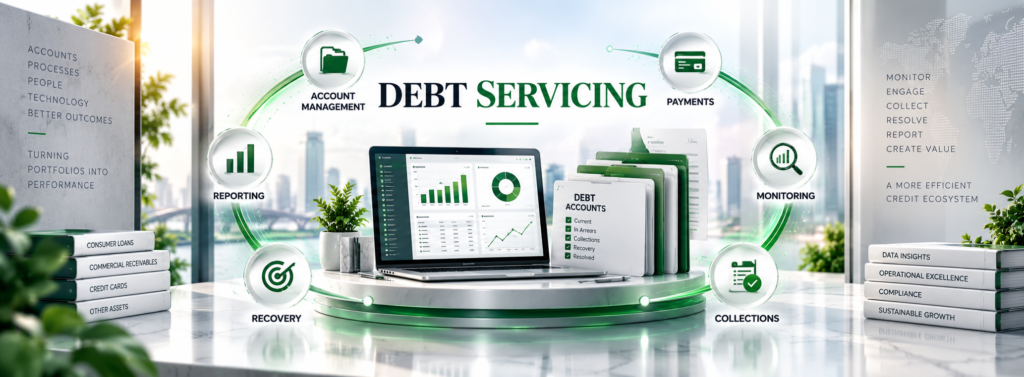
Debt servicing is the operational layer that keeps a credit portfolio functioning after a loan, receivable, or other debt asset has been originated or acquired.
While lending and portfolio transactions determine who owns a debt asset, servicing determines how that asset is administered, monitored, collected and managed throughout its lifecycle.
For a lender, servicing can include payment processing, account administration, customer communication, arrears management and reporting. For a debt buyer or investment manager, servicing becomes equally important after acquisition because portfolio performance depends not only on the quality of the underlying assets but also on how effectively those assets are managed.
This makes debt servicing closely connected to the broader debt sale and purchase market.
A portfolio may move from an originator to a buyer, but the underlying accounts still require ongoing management:
Origination → Servicing → Monitoring → Collections → Recovery → Portfolio Management
When ownership changes, servicing may remain with the existing provider or transition to a new servicer. The quality of that process can influence data integrity, customer treatment, collections, reporting, compliance, and ultimately portfolio performance.
For buyers and sellers, therefore, servicing is not simply an administrative function. It is an important part of portfolio value, transaction due diligence and post-acquisition performance.
What Is Debt Servicing?
Debt servicing refers to the ongoing administration and management of debt accounts.
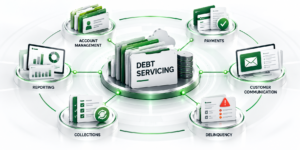
Depending on the asset class, servicing can cover activities such as:
- Payment processing
- Account administration
- Balance management
- Customer communication
- Delinquency monitoring
- Collections
- Payment arrangements
- Reporting
- Reconciliation
- Compliance monitoring
- Recovery management
The scope varies according to the type of debt and the servicing agreement.
A mortgage portfolio, consumer loan portfolio, commercial receivables portfolio and non-performing debt portfolio can require very different servicing models.
At its core, however, servicing connects the financial asset with the operational processes required to manage it.
The Role of Debt Servicing in the Credit Lifecycle
Debt servicing sits across almost every stage of the credit lifecycle.
A simplified lifecycle is:
Origination → Account Management → Payment → Monitoring → Delinquency → Collections → Recovery → Resolution
For performing accounts, servicing may focus primarily on payment administration and account management.
As an account becomes delinquent, the servicing model can become more intensive.
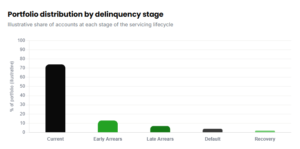
The portfolio may move through:
Current → Early Arrears → Late Arrears → Default → Recovery
Different stages may require different communication, collection and recovery strategies.
This is why servicing cannot be separated from portfolio performance. The information generated during servicing provides a continuous view of how the underlying assets are performing.
Core Debt Servicing Activities
Payment Processing
Payment administration is one of the most fundamental servicing functions.
Servicers may manage:
- Payment collection
- Payment allocation
- Payment reconciliation
- Failed payments
- Payment arrangements
- Account balances
- Payment histories
Accurate payment processing is important because even relatively small account-level errors can become significant when multiplied across a large portfolio.
Account Administration
Account administration maintains the underlying records associated with each debt.
This can include:
- Account status
- Outstanding balance
- Payment history
- Contract information
- Customer information
- Arrears status
- Collection activity
- Recovery status
Maintaining accurate account records is particularly important when portfolios are transferred between owners or servicing platforms.
Customer Communication
Servicing may involve ongoing communication with borrowers or customers.
Depending on the portfolio and applicable requirements, communication can cover:
- Payment reminders
- Account information
- Payment arrangements
- Arrears communication
- Dispute handling
- Resolution information
- Account updates
The communication process can vary significantly depending on whether an account is performing, delinquent, or in recovery.
Delinquency Management
When an account misses a payment, servicing teams may monitor the account and determine the appropriate next action.
Accounts can be segmented according to:
- Days past due
- Outstanding balance
- Payment behaviour
- Previous collection activity
- Customer circumstances
- Product type
- Recovery history
This segmentation allows servicing strategies to be aligned with the characteristics of individual accounts or groups of accounts.
Debt Servicing Models
Debt servicing can be structured in several ways depending on the owner, asset type and operational requirements.
In-House Servicing
The portfolio owner manages servicing internally.
This approach provides direct control over account management, data and operational processes.
It can require significant investment in:
- People
- Technology
- Compliance
- Training
- Reporting
- Collection infrastructure
Third-Party Servicing
The asset owner appoints an external servicing provider.
The provider manages agreed activities on behalf of the owner under a servicing agreement.
This can allow the asset owner to access specialised infrastructure without building the entire servicing operation internally.
Hybrid Servicing
Some activities remain with the portfolio owner while other functions are outsourced.
For example, the owner may retain portfolio oversight and reporting while a specialist provider manages customer communication and collections.
Transitional Servicing
A temporary servicing arrangement may be used when a portfolio changes ownership.
The existing servicer can continue managing the accounts while the buyer prepares its own systems or appoints a new servicing provider.
This can help reduce operational disruption during a portfolio transfer.
Debt Servicing and Portfolio Ownership
Servicing and ownership are not necessarily held by the same organisation.
A simplified structure can be:
Portfolio Owner → Servicer → Customer
The owner holds the relevant economic or contractual interest, while the servicer manages the operational relationship.
In a secondary-market transaction, the structure may change:
Seller → Buyer
while:
Existing Servicer → New Servicer
may or may not change.
This distinction is important during portfolio transactions because a change in ownership does not automatically mean that the servicing arrangement must change.
Debt Servicing in Portfolio Sales
Servicing is a major consideration when a debt portfolio is prepared for sale.
Potential buyers need to understand how the portfolio is currently being managed.
Due diligence may examine:
- Current servicer
- Servicing agreement
- Collection strategy
- Historical performance
- Payment processing
- Account administration
- Technology
- Reporting
- Customer communication
- Compliance processes
- Recovery procedures
The buyer may also assess whether the existing servicing arrangement can continue after acquisition.
If a servicing transition is required, the buyer may need to plan for data migration, system integration and operational handover.
Servicing Due Diligence
Servicing due diligence helps a buyer understand the operational infrastructure behind a portfolio.
Servicing Data
The buyer may review:
- Account records
- Payment history
- Collection notes
- Arrears status
- Recovery information
- Historical performance
Servicing Processes
The review can cover:
- Payment processing
- Customer communication
- Collections
- Escalation
- Dispute management
- Recovery
Technology
Technology assessment can include:
- Account management systems
- Data interfaces
- Reporting platforms
- Payment systems
- Security controls
- Integration capability
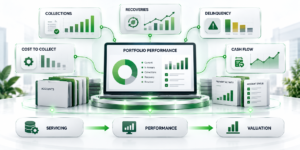
Performance
Historical servicing performance can provide information about:
- Collections
- Recoveries
- Resolution
- Delinquency movement
- Cost to collect
Servicing due diligence therefore gives buyers insight into the operational capability supporting the portfolio.
Servicing and Portfolio Data
Data is the foundation of modern debt servicing.
A servicing platform may need to maintain information covering:
Data Area | Examples |
|---|---|
Account | Account number, product, status |
Balance | Principal, interest, fees |
Payments | Amount, date, allocation |
Delinquency | Days past due, arrears status |
Customer | Relevant account information |
Collections | Actions, contacts, outcomes |
Legal | Proceedings, disputes |
Recovery | Recoveries and costs |
Servicing | Actions, notes, performance |
The quality of this information affects both day-to-day account management and portfolio-level reporting.
Poor data can create operational problems, while structured and validated data can support more effective segmentation, analytics and decision-making.
Technology in Debt Servicing
Technology has transformed the way large debt portfolios are managed.
Modern servicing platforms can support:
- Automated payment processing
- Account segmentation
- Workflow management
- Digital communication
- Collection prioritisation
- Portfolio reporting
- Performance analytics
- Data validation
- Compliance monitoring
- Recovery tracking
Technology also allows servicers to manage large numbers of accounts consistently.
For portfolio owners and debt buyers, the ability to access account-level information and portfolio-level analytics can improve visibility into performance.
Data-Driven Servicing
Debt servicing increasingly relies on portfolio data rather than treating every account identically.
Accounts can be segmented according to characteristics such as:
- Payment history
- Balance
- Delinquency
- Customer behaviour
- Product
- Recovery history
- Previous collection outcomes
This can help servicers determine which accounts require different forms of attention.
For example, a current account may require routine administration, while a long-delinquent account may require a specialised recovery strategy.
The objective is to create a servicing framework that reflects the characteristics of the underlying portfolio.
Debt Servicing and Collections
Collections are one component of debt servicing, particularly when accounts become overdue.
A simplified collection progression may be:
Payment Reminder → Customer Engagement → Payment Arrangement → Collection Activity → Escalation → Recovery
The actual process depends on the asset type, contractual arrangements and applicable requirements.
Collection performance can be measured through indicators such as:
- Payment rates
- Recovery rates
- Resolution rates
- Delinquency movement
- Cost to collect
- Collection effectiveness
Servicing data from these activities can subsequently feed into portfolio analytics and valuation.
Debt Servicing and Recovery
Recovery is generally associated with accounts where normal payment behaviour has broken down.
Recovery strategies may involve:
- Structured payment arrangements
- Settlement processes
- Specialist collections
- Legal recovery
- Asset recovery
- Account resolution
Not every account requires the same recovery approach.
Portfolio segmentation can help determine which accounts require additional attention and which recovery pathways are appropriate.
For a debt buyer, recovery performance can be particularly important because expected recoveries are often incorporated into portfolio valuation.
Debt Servicing and Portfolio Valuation
Servicing can directly influence how a portfolio performs against its acquisition assumptions.
When a buyer evaluates a portfolio, it may estimate:
Expected Collections → Servicing Costs → Recovery Timing → Net Cash Flows
After acquisition, actual servicing performance generates new information.
The owner can compare:
Projected Collections vs Actual Collections
This comparison can reveal whether the portfolio is performing in line with the assumptions used during acquisition.
Servicing therefore becomes part of the feedback loop between:
Acquisition → Servicing → Performance → Valuation
Servicing Costs
Servicing is not cost-free.
Portfolio owners may incur costs associated with:
- Account administration
- Payment processing
- Customer communication
- Collections
- Technology
- Reporting
- Compliance
- Legal recovery
- Data management
For buyers, these costs can form part of portfolio valuation.
A portfolio with strong expected recoveries may still require careful analysis if the cost of servicing and recovery is significant.
This is why portfolio valuation generally considers net expected cash flows, rather than simply gross collections.
Debt Servicing During a Portfolio Transfer
A portfolio transfer introduces additional operational requirements.
The transfer process may include:
Data Extraction → Data Validation → Mapping → System Testing → Account Migration → Reconciliation → Servicing Handover
The objective is to ensure that important account information moves correctly from the seller’s environment to the buyer’s or new servicer’s systems.
Areas that may require attention include:
- Account balances
- Payment history
- Customer information
- Contract information
- Collection notes
- Legal information
- Recovery history
- Account status
A controlled transition reduces the risk of operational disruption.
Transitional Servicing Arrangements
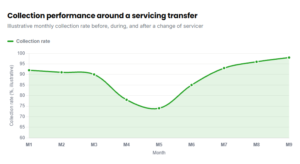
In some portfolio transactions, the existing servicer continues managing accounts for a defined period after the sale.
This can provide time for the buyer to:
- Select a permanent servicer
- Configure systems
- Migrate data
- Test processes
- Establish reporting
- Complete operational onboarding
A transitional arrangement may therefore act as a bridge between transaction closing and long-term servicing.
The terms depend on the transaction structure and the agreements between the relevant parties.
Servicing Performance Management
Portfolio owners need visibility into how servicing is performing.
Common performance indicators can include:
Collection Performance
How much has been collected compared with expectations?
Recovery Performance
How are accounts in recovery performing?
Resolution
How many accounts have reached an agreed resolution?
Delinquency Movement
How are accounts moving between delinquency stages?
Cost to Collect
What operational cost is associated with generating collections?
Servicing Quality
Are accounts being processed accurately and consistently?
Reporting
Is the owner receiving timely and reliable portfolio information?
These measures can be reviewed at account, segment and portfolio level.
Debt Servicing and Secondary Markets
Debt servicing is particularly important in the secondary debt market because assets frequently change ownership without disappearing from the financial system.
A typical transaction may look like:
Originator → Portfolio → Seller → Buyer → Servicer → Customer
The portfolio can change ownership while the underlying obligations remain active.
In some cases:
Seller → Buyer
changes while:
Servicer → Servicer
remains unchanged.
In others, both ownership and servicing change.
This makes servicing arrangements an important component of transaction planning.
Servicing and Debt Buyers
For debt buyers, servicing capability can be as important as acquisition strategy.
After purchasing a portfolio, the buyer needs infrastructure capable of:
- Receiving portfolio data
- Managing accounts
- Processing payments
- Communicating with customers
- Managing collections
- Monitoring performance
- Producing reports
- Managing recoveries
A buyer may therefore evaluate the servicing model before completing an acquisition.
This is one reason servicing due diligence forms an important part of debt portfolio transactions.
Servicing and Reporting
Portfolio reporting creates the connection between operational activity and investment management.
Reports may provide information on:
- Collections
- Recoveries
- Delinquency
- Account status
- Payment arrangements
- Servicing activity
- Costs
- Cash flows
At portfolio level, this information helps owners understand whether actual performance is consistent with acquisition assumptions.
At account level, it helps servicing teams manage individual obligations.
A well-designed reporting framework therefore needs to operate at both levels.
Servicing Risk
Debt servicing involves several operational and financial risks.
Data Risk
Incorrect or incomplete account information can affect servicing and reporting.
Technology Risk
System failures or integration problems can disrupt account management.
Operational Risk
Weak processes can result in errors, delays or inconsistent account handling.
Compliance Risk
Servicing activities need to operate within the applicable legal and regulatory framework.
Transition Risk
Moving a portfolio between systems or servicers can create data and operational challenges.
Performance Risk
Actual collections may differ from expectations due to changes in account behaviour or recovery conditions.
Effective servicing requires controls designed to identify and manage these risks throughout the portfolio lifecycle.
Outsourcing Debt Servicing
Some portfolio owners use external servicing providers rather than managing all operations internally.
Potential reasons can include:
- Access to specialist infrastructure
- Scalability
- Technology capability
- Collection expertise
- Geographic coverage
- Operational efficiency
- Portfolio-specific expertise
When selecting a servicer, an owner may assess:
- Technology
- Track record
- Reporting
- Data security
- Collection capability
- Compliance framework
- Recovery capability
- Pricing structure
- Scalability
The servicing agreement should define the responsibilities, performance requirements and reporting obligations of the parties.
Debt Servicing After Acquisition
The completion of a portfolio acquisition marks the beginning of another stage of portfolio management.

A simplified post-acquisition framework is:
Transfer → Onboarding → Servicing → Monitoring → Collections → Recovery → Performance Review
During onboarding, the buyer and servicer may validate account information and establish operational processes.
Once servicing is active, portfolio performance can be monitored against the original acquisition assumptions.
Over time, the resulting performance data can inform:
- Portfolio strategy
- Servicing strategy
- Valuation updates
- Recovery planning
- Future portfolio transactions
This makes servicing a continuous part of the investment lifecycle rather than a one-time administrative activity.
The Role of Servicing in Portfolio Sales
Servicing information can influence a portfolio’s attractiveness before it is sold.
Potential buyers may want to understand:
- Who currently services the portfolio
- How accounts are managed
- Historical collection performance
- Servicing costs
- Technology infrastructure
- Recovery processes
- Reporting capabilities
- Transfer requirements
A seller that can provide clear servicing information can make it easier for potential buyers to understand the operational requirements associated with the portfolio.
After acquisition, the buyer can then determine whether to retain, replace or restructure the servicing arrangement.