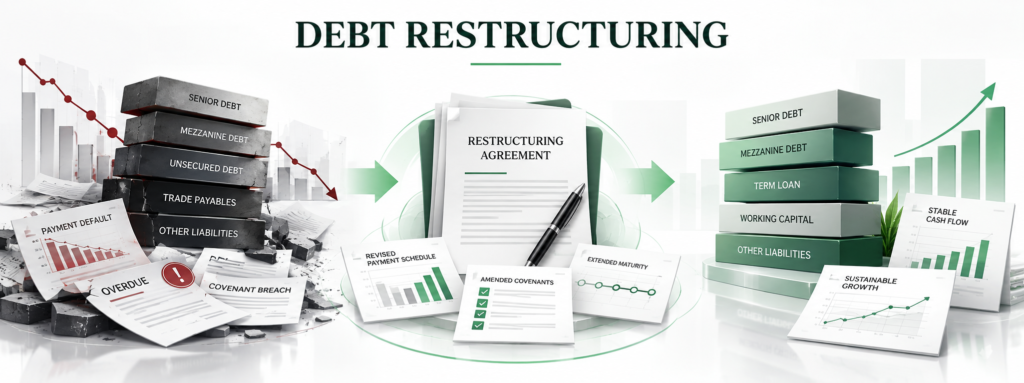
Debt restructuring is the process of changing the terms or structure of existing debt to help a borrower manage financial pressure, improve liquidity, or avoid a more severe credit event.
It can involve changes to interest rates, repayment schedules, maturity dates, principal amounts, covenants, security arrangements, payment structures, or ownership of the underlying debt. The exact approach depends on the borrower’s financial position, the type of debt, the lender’s objectives, and the legal and commercial circumstances.
For lenders, investors and credit managers, debt restructuring is not simply about reducing what a borrower owes. It is about determining whether a revised structure can create a more sustainable path for repayment while protecting the interests of creditors.
A typical restructuring framework can be viewed as:
Financial Stress → Assessment → Negotiation → Restructuring Plan → Implementation → Monitoring → Resolution
Debt restructuring is closely connected with distressed debt, distressed investing, private credit, NPL management, debt servicing, portfolio management and debt recovery. It can also play an important role in the secondary credit market, where investors acquire stressed or distressed debt and evaluate whether restructuring can improve recovery outcomes.
What Is Debt Restructuring?
Debt restructuring involves modifying the existing terms of debt when the original repayment arrangement is no longer appropriate, sustainable or commercially optimal.
A borrower may experience financial pressure because of:
- Declining revenue
- Higher operating costs
- Interest-rate increases
- Refinancing difficulties
- Liquidity shortages
- Excessive leverage
- Industry disruption
- Unexpected financial obligations
- Deteriorating asset values
Rather than immediately moving toward enforcement or insolvency, creditors and borrowers may explore a restructuring arrangement.
Depending on the circumstances, restructuring can change the timing, cost, amount, security or structure of debt.
The objective is generally to create a structure that better reflects the borrower’s financial capacity while addressing the creditor’s recovery expectations.
Why Does Debt Restructuring Occur?
Debt restructuring can occur for different reasons, and financial distress is not always the result of a single event.
Liquidity Pressure
A borrower may have assets or long-term earning potential but insufficient cash flow to meet near-term obligations.
Restructuring can potentially shift repayments to better align with expected cash generation.
Excessive Leverage
A highly leveraged borrower may have debt obligations that are disproportionate to its current earnings.
Creditors may consider restructuring the capital structure to improve sustainability.
Refinancing Challenges
A borrower approaching maturity may be unable to refinance its existing debt on acceptable terms.
Extending maturity or changing repayment conditions can form part of a restructuring strategy.
Business Performance Deterioration
Reduced revenue or profitability can weaken debt-service capacity.
A restructuring may be considered if the underlying business remains viable.
Changing Market Conditions
Interest rates, commodity prices, property values, currency movements and broader economic conditions can affect a borrower’s ability to service debt.
Distressed Credit Portfolio Management
Lenders and investors managing distressed credit portfolios may use restructuring as one of several recovery strategies.
This creates a direct connection between debt restructuring and distressed investing.
Types of Debt Restructuring
There is no single restructuring structure. The appropriate approach depends on the underlying credit exposure and the parties involved.

Maturity Extension
The repayment date is extended to provide additional time for the borrower to meet its obligations.
A maturity extension can reduce immediate refinancing pressure while allowing creditors to maintain exposure to the borrower.
Interest Rate Modification
The interest rate or pricing structure may be changed.
This can reduce short-term debt-service pressure, although the commercial effect depends on the wider restructuring agreement.
Payment Rescheduling
Payments can be reorganised over a different period.
For example, a repayment structure may be changed from a concentrated maturity payment to a more gradual schedule.
Principal Reduction
In certain restructuring situations, creditors may agree to reduce a portion of the outstanding principal.
This is typically considered in more severe financial distress and depends heavily on the circumstances and creditor negotiations.
Interest Deferral
Interest payments may be deferred for an agreed period.
Depending on the restructuring terms, deferred interest may accrue or be capitalised.
Covenant Restructuring
Financial or operational covenants may be modified to reflect the borrower’s revised circumstances.
Debt-to-Equity Conversion
In some corporate restructuring situations, part of the debt may be exchanged for an ownership interest.
This can alter the creditor’s position within the capital structure.
Debt Restructuring vs. Debt Refinancing
Debt restructuring and refinancing are related but different concepts.
Refinancing generally involves replacing existing debt with new financing.
Debt restructuring involves changing the terms or structure of existing obligations, often because the current arrangement has become difficult to maintain or no longer reflects the borrower’s circumstances.
For example:
Existing Loan → New Loan
may represent refinancing.
Whereas:
Existing Loan → Revised Maturity + Revised Payments + Revised Covenants
is more characteristic of restructuring.
In practice, the two can sometimes occur together.
The Debt Restructuring Process
A successful restructuring requires more than simply changing repayment terms.

1. Identify Financial Stress
The first step is understanding why the existing debt structure has become difficult to maintain.
This may involve analysing:
- Cash flow
- Revenue
- Profitability
- Liquidity
- Existing debt
- Upcoming maturities
- Collateral
- Business forecasts
2. Assess Debt Capacity
Creditors need to understand what the borrower can realistically support.
This involves evaluating projected cash flows and determining the sustainable level of debt service.
3. Review the Capital Structure
The entire debt structure may need to be examined rather than focusing on one facility.
This can include:
- Senior debt
- Secured debt
- Unsecured debt
- Mezzanine financing
- Shareholder loans
- Other financial obligations
4. Conduct Due Diligence
Financial, legal and operational due diligence can help establish the underlying position.
Documentation, security, guarantees, contracts and existing creditor rights may all be relevant.
5. Develop Restructuring Scenarios
Multiple alternatives can be assessed.
For example:
Scenario A: Maturity extension
Scenario B: Payment restructuring
Scenario C: Interest modification
Scenario D: Partial debt reduction
Scenario E: Debt-to-equity restructuring
Each scenario can have different implications for both borrower and creditor.
6. Negotiate
The parties negotiate the terms of the proposed restructuring.
The process can involve borrowers, lenders, investors, advisors, legal representatives and other stakeholders.
7. Document and Implement
Once an agreement is reached, the revised terms need to be formally documented and implemented.
8. Monitor Performance
Restructuring does not end when the agreement is signed.
Ongoing monitoring is important to determine whether the revised structure is performing as expected.
Debt Restructuring Due Diligence
Due diligence is central to restructuring because the revised debt structure needs to be based on realistic financial information.
Financial Due Diligence
Financial analysis can include:
- Historical financial performance
- Cash-flow statements
- Revenue trends
- Operating costs
- Existing debt
- Liquidity
- Working capital
- Forecast cash flow
The key question is whether the borrower has sufficient capacity to support the proposed structure.
Legal Due Diligence
Legal review can cover:
- Loan agreements
- Security documents
- Guarantees
- Covenants
- Enforcement rights
- Existing defaults
- Intercreditor arrangements
- Regulatory requirements
Operational Due Diligence
Operational factors can be equally important.
Creditors may need to understand:
- Business operations
- Customer concentration
- Supplier relationships
- Management structure
- Technology
- Cost base
- Operational risks
A restructuring can fail if financial projections look reasonable but the underlying business cannot generate the expected cash flow.
Debt Restructuring and Cash Flow
Cash flow is one of the most important considerations in debt restructuring.
A borrower may have significant assets but still experience liquidity pressure if cash is unavailable when debt payments fall due.
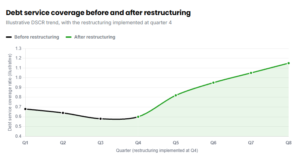
A simplified restructuring analysis can be represented as:
Operating Cash Flow → Debt Service → Liquidity → Future Obligations
The restructuring structure should consider the timing of expected cash flows rather than simply looking at the total amount of debt outstanding.
This is particularly important where a borrower has:
- Seasonal revenue
- Long receivable cycles
- Large contractual payments
- Significant refinancing requirements
- Project-based cash flows
A revised repayment schedule can sometimes better align debt obligations with the underlying cash-flow profile.
Debt Restructuring and Distressed Debt
Debt restructuring is closely associated with distressed debt investing.
When a credit exposure becomes distressed, investors may evaluate whether restructuring can improve the expected recovery compared with immediate enforcement or liquidation.
For a distressed investor, the analysis may involve:
Purchase Price → Restructuring Strategy → Revised Cash Flows → Recovery → Exit
The investor may evaluate different restructuring outcomes before acquiring the debt.
This is one reason distressed investors pay close attention to:
- Legal rights
- Capital structure
- Security
- Borrower cash flow
- Recovery scenarios
- Restructuring options
Debt Restructuring in Private Credit
Private credit investors can also encounter restructuring situations.
A private credit portfolio may contain loans to businesses that experience changes in financial performance or liquidity.
When a borrower encounters difficulty, the lender may evaluate whether to:
- Amend loan terms
- Extend maturity
- Modify covenants
- Change payment schedules
- Provide additional capital
- Restructure existing debt
- Pursue enforcement
The appropriate response depends on the credit agreement, borrower circumstances and expected recovery.
This makes private credit and debt restructuring closely connected areas of credit management.
Debt Restructuring and NPLs
Non-performing loans (NPLs) can become candidates for restructuring where there is a realistic path toward repayment or recovery.
However, restructuring is not appropriate for every NPL.
Creditors may consider:
- Borrower willingness to repay
- Sustainable repayment capacity
- Asset position
- Previous payment behaviour
- Legal position
- Recovery alternatives
- Cost of enforcement
For portfolios containing large numbers of NPLs, segmentation can help identify which accounts may be suitable for restructuring and which may require alternative recovery strategies.
A simplified portfolio framework can be:
Current → Early Arrears → Late Arrears → Default → Restructuring / Recovery
Debt Restructuring and Portfolio Management
For lenders and investors managing credit portfolios, restructuring decisions can affect the performance of the wider portfolio.
Portfolio managers may analyse exposures according to:
- Industry
- Geography
- Product
- Delinquency
- Outstanding balance
- Collateral
- Borrower type
- Recovery history
This allows restructuring strategies to be tailored to different segments.
For example, a viable corporate borrower with temporary liquidity pressure may require a different approach from a severely impaired credit exposure with limited recovery prospects.
Benefits of Debt Restructuring
When appropriate, restructuring can provide several potential benefits.
For Borrowers
It may:
- Improve liquidity
- Reduce immediate repayment pressure
- Extend repayment periods
- Align debt service with cash flow
- Provide additional time for business recovery
For Creditors
It may:
- Preserve a potentially viable credit relationship
- Avoid immediate enforcement costs
- Improve recovery prospects
- Provide greater visibility into future cash flows
- Reduce the risk of an uncontrolled resolution process
The outcome depends on the specific restructuring terms and the underlying financial situation.
Risks of Debt Restructuring
Debt restructuring also carries significant risks.
Execution Risk
A restructuring agreement may be difficult to implement or may not achieve the expected outcome.
Forecast Risk
Future cash-flow projections may prove inaccurate.
Legal Risk
Documentation, security or creditor-rights issues can affect the restructuring.
Business Risk
The underlying borrower may continue to deteriorate despite revised debt terms.
Recovery Risk
The revised arrangement may ultimately produce lower recoveries than expected.
Stakeholder Risk
Different creditors may have competing interests or different views about the appropriate restructuring strategy.
Monitoring Risk
A restructuring requires ongoing monitoring. Weak reporting can make it difficult to identify renewed financial stress.
Debt Restructuring and Recovery Strategies
Restructuring should generally be considered alongside other recovery strategies rather than in isolation.
Depending on the situation, creditors may evaluate:
Restructuring → Refinancing → Asset Sale → Settlement → Enforcement → Recovery
The preferred approach depends on the expected outcome, cost, timing and legal position.
For distressed investors and debt buyers, this comparison is particularly important when determining whether to pursue restructuring or another recovery route.
Technology in Debt Restructuring
Technology can support restructuring analysis by bringing together large volumes of financial and account-level information.
Modern credit platforms can help with:
- Portfolio segmentation
- Cash-flow analysis
- Account monitoring
- Covenant tracking
- Payment history
- Restructuring status
- Recovery forecasting
- Portfolio reporting
For large credit portfolios, automated data processing can help identify accounts showing signs of financial deterioration before they become severely distressed.
Technology can therefore support both early intervention and post-restructuring monitoring.
Monitoring a Restructured Debt Portfolio
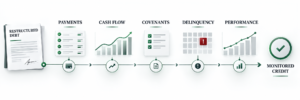
A restructuring should be treated as an ongoing credit-management process.
Following implementation, creditors may monitor:
- Payment performance
- Cash flow
- Covenant compliance
- Liquidity
- Delinquency
- Recovery progress
- Outstanding balance
- Revised repayment schedule
A useful framework is:
Original Terms → Financial Stress → Restructuring → Revised Terms → Monitoring → Resolution
If performance deteriorates again, creditors may need to reassess the restructuring strategy.
Debt Restructuring in the Secondary Credit Market
Debt restructuring can also create opportunities in the secondary credit market.
A lender may decide to sell a stressed credit portfolio rather than continue managing the exposure.
A debt buyer may acquire the portfolio after evaluating:
- Current balances
- Borrower condition
- Documentation
- Legal rights
- Existing restructuring arrangements
- Recovery potential
- Servicing requirements
The new owner may then determine whether to continue, modify or replace the existing restructuring strategy.
This connects:
Portfolio Sales → Distressed Investing → Debt Restructuring → Servicing → Recovery
Debt Restructuring vs. Debt Settlement
Debt restructuring should also be distinguished from debt settlement.
Debt restructuring generally changes the terms or structure of an existing debt obligation.
Debt settlement generally involves an agreement to resolve an outstanding obligation, potentially for an amount different from the original amount owed.
The legal, financial and commercial implications can differ significantly depending on the specific arrangement and jurisdiction.
How Investors Evaluate a Restructuring Opportunity
For investors evaluating a distressed or restructured credit exposure, several questions are important:
What caused the financial stress?
Understanding the underlying problem helps determine whether it is temporary or structural.
Is the borrower viable?
A restructuring may make more sense when the underlying business or cash-flow source remains viable.
What is the realistic recovery?
Recovery analysis should consider cash flows, collateral, legal rights, costs and timing.
What restructuring options exist?
Investors may compare multiple scenarios rather than relying on a single forecast.
What happens if restructuring fails?
Downside scenarios can include enforcement, liquidation, asset sales or further restructuring.
What is the appropriate value?
The investment assessment should consider risk-adjusted future cash flows rather than simply the original face value of the debt.