
The startup funding environment in 2026 looks very different from the era of easy money. Founders are facing tighter venture capital scrutiny, longer fundraising cycles, and greater pressure to demonstrate capital efficiency. As a result, one question is dominating boardrooms and annual planning discussions: venture debt vs equity — which funding route makes sense now?
With search interest surging around non-dilutive startup funding, founders are actively comparing dilution risk against runway extension. Understanding when to use venture debt, when equity still makes sense, and how the two can work together has become critical for survival and long-term value creation.
Venture Debt vs Equity: 2026 Funding Reality for Startups
In 2026, capital is not scarce, but it is selective. Investors are prioritizing startups with predictable revenue, strong unit economics, and a clear path to profitability. This shift has pushed many founders to rethink traditional equity-heavy funding strategies.
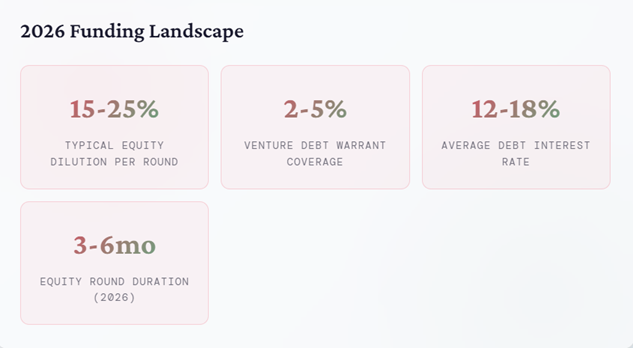
Equity rounds are taking longer to close, valuations are more conservative, and down rounds remain a real concern. Against this backdrop, venture debt has moved from a niche instrument to a mainstream funding option for growth-stage startups seeking flexibility.
The venture debt vs equity debate is no longer theoretical. It directly impacts founder ownership, board control, exit outcomes, and operational freedom.
What Is Venture Debt?
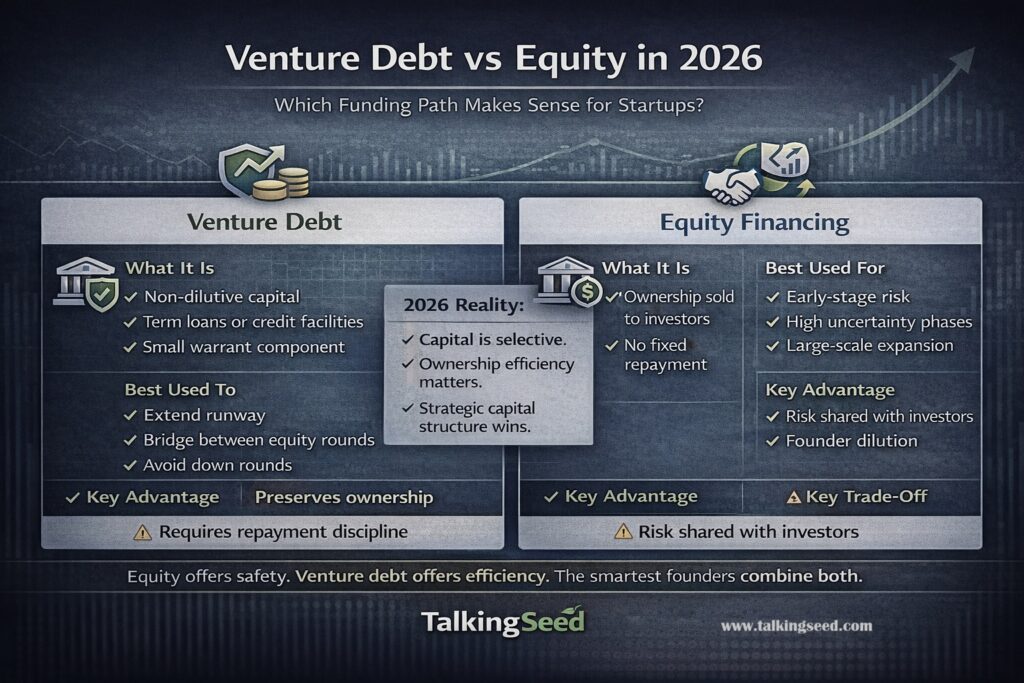
Venture debt is a form of non-dilutive startup funding provided by specialized lenders to venture-backed companies. Unlike equity, venture debt does not require founders to give up ownership in exchange for capital.
Typically, venture debt comes as a term loan or revolving credit facility, often accompanied by small warrants. These warrants give lenders limited upside but are far less dilutive than issuing new equity.
Venture debt is usually used to:
- Extend cash runway
- Fund working capital needs
- Support growth between equity rounds
- Avoid raising equity at unfavorable valuations
Understanding when to use venture debt depends heavily on a startup’s revenue stability and funding history.
What Is Equity Financing?
Equity financing involves selling ownership stakes to investors in exchange for capital. This remains the most common funding route for early-stage startups with limited revenue and high uncertainty.
Equity capital is patient, risk-tolerant, and does not require fixed repayments. However, it comes with dilution, governance obligations, and long-term expectations around exit timing and scale.
In the venture debt vs equity comparison, equity offers safety in volatility, while venture debt offers efficiency when growth is more predictable.
Venture Debt vs Equity: Core Differences
The decision between venture debt and equity hinges on how founders value ownership, risk, and control.
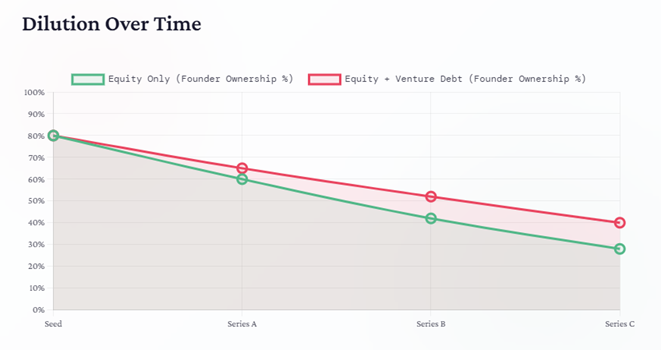
Dilution
Equity funding permanently reduces founder ownership. Venture debt, by contrast, preserves equity and limits dilution to small warrant components.
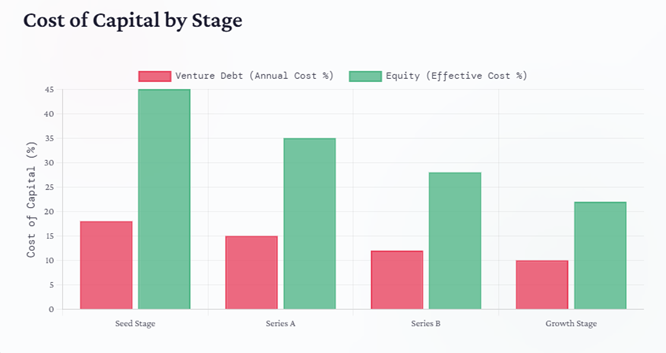
Cost of Capital
While venture debt involves interest payments, it is often cheaper in the long run than equity, especially if the company scales successfully.
Risk Exposure
Equity investors share business risk. Venture debt introduces repayment obligations, which can increase pressure if cash flows decline.
Control and Governance
Equity investors often require board seats and veto rights. Venture debt lenders typically focus on financial covenants rather than operational control.
For founders sensitive to ownership and governance, venture debt vs equity becomes a strategic trade-off rather than a financial one.
When to Use Venture Debt in 2026
Knowing when to use venture debt is essential to avoiding financial strain. Venture debt works best under specific conditions.
Startups with recurring revenue models, such as SaaS, fintech, and subscription-based platforms, are ideal candidates. Predictable cash inflows reduce default risk and make debt servicing manageable.
Venture debt is particularly effective when:
- A startup has recently raised equity and wants to extend its runway
- Valuations are temporarily depressed
- Growth capital is needed without triggering dilution
- The business is approaching breakeven
In 2026, many founders are using venture debt strategically to delay equity raises until market conditions improve.
When Equity Still Makes More Sense
Despite the rise of non-dilutive startup funding, equity remains essential in several scenarios.
Early-stage startups with pre-revenue models often lack the cash flow required to service debt. For these companies, equity provides the flexibility to experiment, pivot, and scale without repayment pressure.
Equity funding is also preferable when:
- Business models are still unproven
- Revenue visibility is low
- Large upfront investments are required
- Strategic investors bring operational value beyond capital
In the venture debt vs equity decision, equity is still the foundation for high-risk innovation.
The Hybrid Approach: Debt and Equity Together
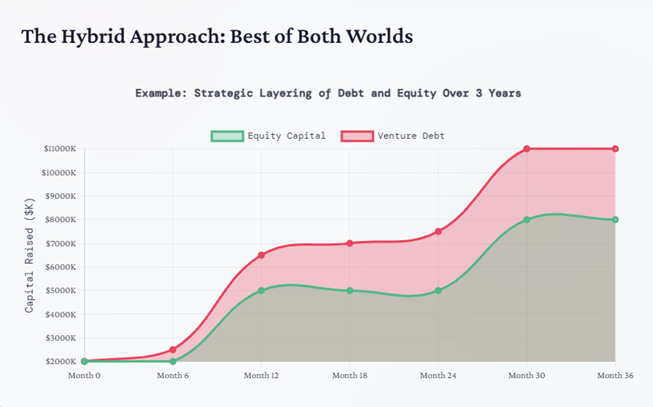
Increasingly, startups in 2026 are not choosing between venture debt and equity — they are using both.
A hybrid funding strategy allows founders to optimize capital structure. Equity funds core growth and risk-taking, while venture debt supports operational efficiency and tactical expansion.
This blended approach:
- Reduces overall dilution
- Improves capital efficiency metrics
- Strengthens negotiating power in future equity rounds
- Aligns funding sources with business maturity
Founders who understand venture debt vs equity as complementary tools gain a significant strategic advantage.
Impact on Founder Ownership and Exit Outcomes
One of the most overlooked aspects of the venture debt vs equity debate is its impact on exit outcomes.
Excessive equity dilution can significantly reduce founder payouts at acquisition or IPO. Venture debt, used responsibly, preserves ownership and amplifies upside.
However, misusing venture debt can also harm exit prospects. Overleveraged balance sheets may deter acquirers or reduce valuation multiples.
In 2026, investors and buyers are scrutinizing capital structures more closely. Balanced use of non-dilutive startup funding is increasingly viewed as a sign of financial maturity.
Venture Debt Risks Founders Must Not Ignore
While venture debt offers compelling benefits, it is not risk-free.
Repayment obligations create fixed financial pressure. Missed revenue targets or delayed customer payments can quickly turn manageable debt into a crisis.
Other risks include:
- Restrictive covenants limiting operational flexibility
- Refinancing challenges during downturns
- Increased stress on cash flow management
Understanding when to use venture debt also means knowing when not to. Debt should never replace sustainable growth fundamentals.
How Investors View Venture Debt in 2026
Contrary to past perceptions, venture investors in 2026 are generally supportive of venture debt — when used wisely.
Many VCs now encourage founders to use non-dilutive startup funding to improve capital efficiency and extend runway without repeated equity dilution.
However, investors remain cautious about excessive leverage. Transparency around debt terms and repayment plans is essential to maintaining investor confidence.
In the evolving venture debt vs equity landscape, alignment with existing investors matters as much as lender selection.
Choosing the Right Funding Path in 2026
There is no universal answer to the venture debt vs equity question. The right choice depends on stage, revenue predictability, growth strategy, and market conditions.
Founders should assess:
- Current and projected cash flows
- Valuation environment
- Ownership goals
- Risk tolerance
- Long-term exit strategy
In 2026, capital strategy is no longer just about raising money. It is about designing a funding mix that supports resilience, flexibility, and value creation.
Final Perspective for Founders Planning 2026
The rise of venture debt reflects a broader shift in startup thinking. Growth at any cost is no longer rewarded. Capital efficiency, disciplined scaling, and ownership preservation now define strong companies.
Understanding venture debt vs equity, recognizing when to use venture debt, and strategically leveraging non-dilutive startup funding can materially change a startup’s trajectory.
Founders who approach funding as a strategic design decision — rather than a reactive necessity — will be best positioned to thrive in 2026’s demanding but opportunity-rich environment.