
In a year marked by global economic tension, cautious investors, and fluctuating startup valuations, 2026 is shaping up to be a turning point in how startups raise capital. Once considered a niche financing tool, venture debt is rapidly moving into the spotlight as founders seek alternatives to traditional equity funding. With dilution concerns rising and venture capital firms tightening their purse strings, startups across sectors are increasingly turning to non-dilutive financing to sustain growth.
This shift is not just a temporary adjustment—it signals a deeper transformation in the startup funding landscape.
A Funding Environment Under Pressure
The startup ecosystem in 2026 is operating under significantly different conditions compared to the boom years of 2020–2022. Rising interest rates, geopolitical instability, and investor caution have slowed venture capital deployment globally. Many startups that once commanded premium valuations are now facing down rounds or extended fundraising cycles.
As a result, founders are reevaluating their funding strategies. Instead of giving away larger equity stakes at lower valuations, many are opting for venture debt to extend their runway while preserving ownership.
Industry analysts report a notable increase in venture debt deals in the first quarter of 2026, particularly among Series A and Series B startups. These companies, often caught between early traction and profitability, are the most vulnerable to valuation pressures—and the most likely to benefit from debt financing.
What Is Venture Debt and Why It’s Gaining Traction
Venture debt is a type of financing provided to startups that already have backing from venture capital investors. Unlike equity financing, it does not require founders to give up ownership in exchange for capital. Instead, startups receive a loan that must be repaid over time, typically with interest and sometimes with warrants.
The appeal is clear: founders can access capital without diluting their stake, maintain control over decision-making, and bridge funding gaps between equity rounds.
In 2026, venture debt is no longer just a supplementary tool—it is becoming a strategic component of startup financing. Companies are using it not only to extend runway but also to fund specific growth initiatives such as product launches, market expansion, or acquisitions.

Venture Debt vs Equity: A Strategic Trade-Off
The debate between venture debt and equity financing is not new, but it has taken on new urgency in today’s market conditions.
Equity financing offers startups the advantage of risk-sharing. Investors bear the downside if the company fails, and there is no obligation for repayment. However, this comes at the cost of ownership dilution and often increased investor control.
Venture debt, on the other hand, allows founders to retain equity but introduces financial obligations. Startups must generate enough revenue or secure future funding to repay the debt, making it a riskier option for companies with uncertain cash flows.
In 2026, the balance is shifting. With valuations under pressure, the cost of equity has effectively increased. Founders are more reluctant to give up large portions of their company at discounted valuations, making venture debt a more attractive option despite its risks.
Startups Leading the Shift
Several high-growth startups in fintech, SaaS, and healthtech sectors have already embraced venture debt as a primary funding tool in 2026. These companies are leveraging strong unit economics and predictable revenue streams to secure favorable debt terms.
For example, SaaS companies with recurring revenue models are particularly well-suited for venture debt. Their predictable cash flows make them attractive to lenders, who are increasingly willing to offer flexible repayment structures.
Similarly, fintech startups are using venture debt to scale operations without diluting equity, especially in markets where regulatory changes have slowed investor enthusiasm.
This trend is also gaining momentum among late-stage startups preparing for IPOs. By using venture debt to extend their runway, these companies can delay public listings until market conditions improve, potentially achieving higher valuations.
The Role of Lenders in 2026
The rise of venture debt is not happening in isolation. It is being fuelled by a growing ecosystem of specialized lenders, including banks, private credit funds, and venture debt firms.
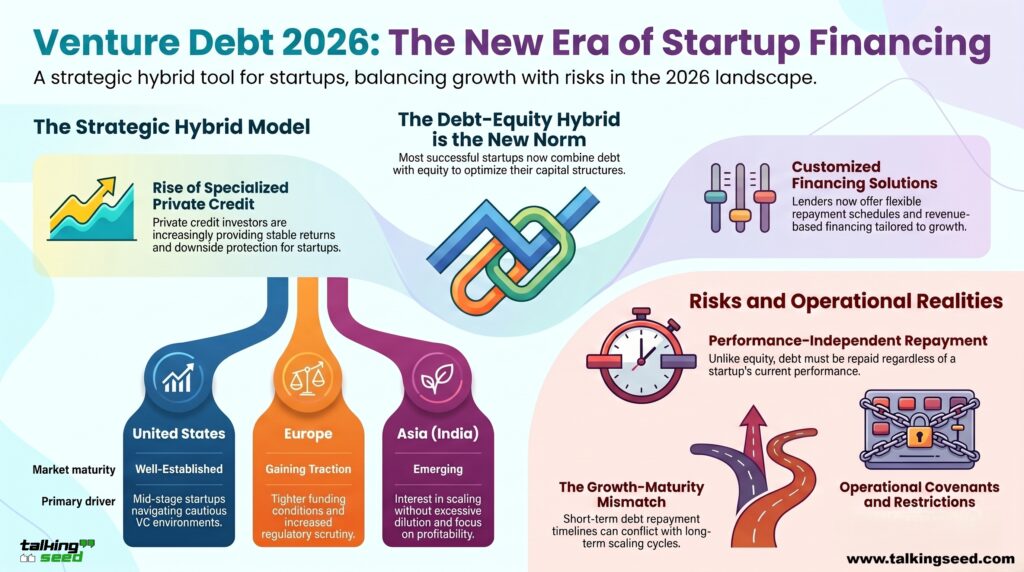
In 2026, these lenders are becoming more sophisticated in their approach. They are offering customized financing solutions tailored to the needs of startups, including flexible repayment schedules, revenue-based financing, and hybrid debt-equity instruments.
Competition among lenders is also driving innovation. Startups now have access to a wider range of financing options, enabling them to choose structures that align with their growth strategies.
However, this increased availability of debt capital also raises concerns about over-leveraging. As more startups take on debt, the risk of defaults could rise, particularly if economic conditions worsen.
Risks and Challenges
While venture debt offers clear advantages, it is not without risks. Unlike equity, debt must be repaid regardless of the company’s performance. This can create significant pressure on startups, especially those that are not yet profitable.
In a volatile market, revenue projections can quickly change, making it difficult for startups to meet repayment obligations. Defaults could lead to asset seizures, loss of control, or even bankruptcy.
Moreover, venture debt agreements often come with covenants and restrictions that can limit operational flexibility. Founders must carefully evaluate these terms to avoid unintended consequences.
Another challenge is the potential mismatch between debt financing and startup growth cycles. Startups typically require long-term capital to scale, while debt financing often has shorter repayment timelines. This mismatch can create liquidity challenges if not managed properly.
A Complement, Not a Replacement
Despite the growing popularity of venture debt, industry experts caution against viewing it as a complete replacement for equity financing.
Equity remains essential for early-stage startups that lack the revenue or stability to support debt. It also provides strategic value through investor expertise, networks, and mentorship.
In most cases, the optimal approach is a balanced funding strategy that combines both equity and debt. Venture debt can be used to complement equity financing, reducing dilution while providing additional capital for growth.
In 2026, this hybrid model will become the norm. Startups are increasingly using venture debt alongside equity rounds to optimize their capital structure and maximize shareholder value.
Global Trends and Regional Insights
The rise of venture debt is a global phenomenon, but its adoption varies by region.
In the United States, venture debt has been a well-established financing tool for years. In 2026, its usage is expanding rapidly, particularly among mid-stage startups navigating a more cautious venture capital environment.
In Europe, venture debt is gaining traction as startups face tighter funding conditions and increased regulatory scrutiny. Governments and financial institutions are also playing a role by supporting alternative financing models.
In Asia, including India, venture debt is emerging as a viable option for startups seeking to scale without excessive dilution. The region’s growing startup ecosystem and increasing investor sophistication are driving demand for non-dilutive capital.
Indian startups, in particular, are showing strong interest in venture debt as they navigate a funding slowdown and focus on profitability. This trend is expected to accelerate in the coming years.
Investor Perspective: A Shift in Risk Appetite
The growing interest in venture debt also reflects a broader shift in investor behavior.
Venture capitalists are becoming more selective, prioritizing sustainable growth and profitability over rapid expansion. This shift is influencing how startups approach fundraising.
At the same time, private credit investors are stepping in to fill the gap left by traditional venture capital. These investors are attracted by the potential for stable returns and downside protection offered by debt financing.
This convergence of interests is reshaping the startup funding ecosystem, creating new opportunities and challenges for founders.
What Lies Ahead for 2026 and Beyond
As 2026 unfolds, the role of venture debt in startup financing is expected to continue growing. However, its long-term impact will depend on how startups and investors navigate the associated risks.
If managed effectively, venture debt could become a cornerstone of startup financing, enabling founders to build sustainable businesses without excessive dilution.
At the same time, the industry must address potential risks, including over-leveraging and default rates, to ensure the stability of the ecosystem.
The question is not whether venture debt will replace equity—but how the two will coexist in a rapidly evolving market.
The Bigger Picture: A New Funding Paradigm
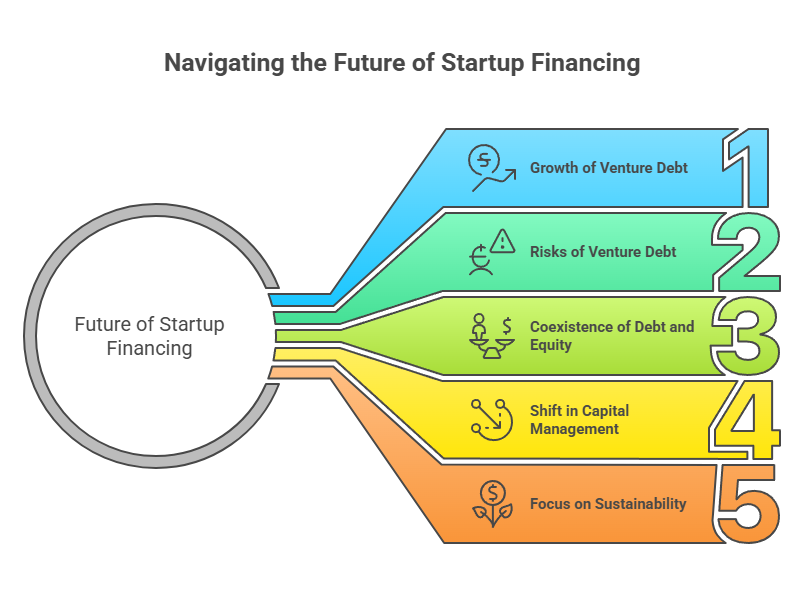
The rise of venture debt in 2026 reflects a broader shift toward more disciplined and strategic capital management in the startup world.
Founders are no longer chasing growth at any cost. Instead, they are focusing on efficiency, sustainability, and long-term value creation.
In this new environment, venture debt offers a powerful tool—but only when used wisely.
As startups continue to adapt to changing market conditions, one thing is clear: the future of startup financing will be more diverse, more flexible, and more complex than ever before.
And in that future, venture debt will play a central—though not solitary—role.