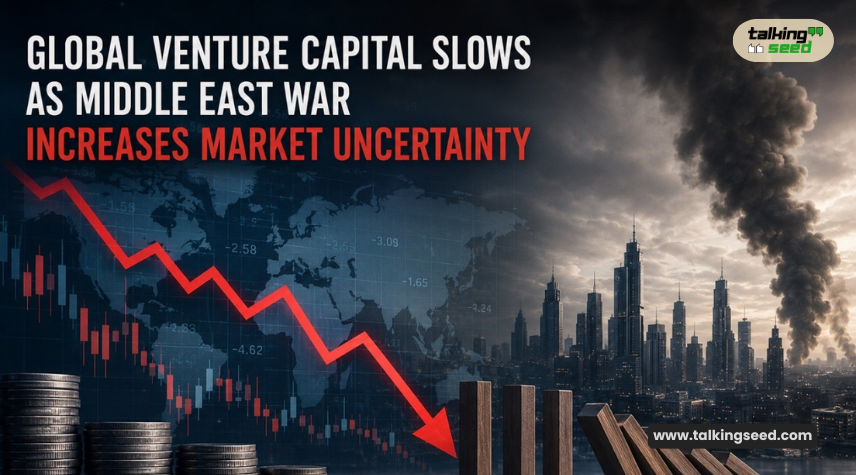
The global startup ecosystem is facing a major setback in 2026 as venture capital activity slows sharply amid escalating tensions in the Middle East. Investors across the world are becoming increasingly cautious as geopolitical uncertainty, volatile oil prices, inflation fears, and unstable financial markets combine to create one of the most difficult funding environments since the post-pandemic correction.
The ongoing Middle East conflict has triggered widespread concern among institutional investors, venture capital firms, sovereign wealth funds, and technology founders. As capital preservation becomes the priority, many investors are delaying new funding rounds, reducing risk exposure, and focusing only on late-stage or profitable companies.
Analysts say the latest venture capital slowdown trend in 2026 is not isolated to one region or industry. Instead, it reflects a broader global economic shift where uncertainty is reshaping investment behavior. From Silicon Valley to Europe, India, Southeast Asia, and the Middle East itself, startups are now struggling to secure funding at valuations that were once considered standard.
Venture Capital Market Faces Sharp Cooling
Global venture capital trends indicate that total startup funding has dropped significantly compared to the previous year. Market intelligence firms tracking startup investments report a decline in mega funding rounds, especially in high-risk sectors such as artificial intelligence infrastructure, fintech, mobility, and consumer technology.
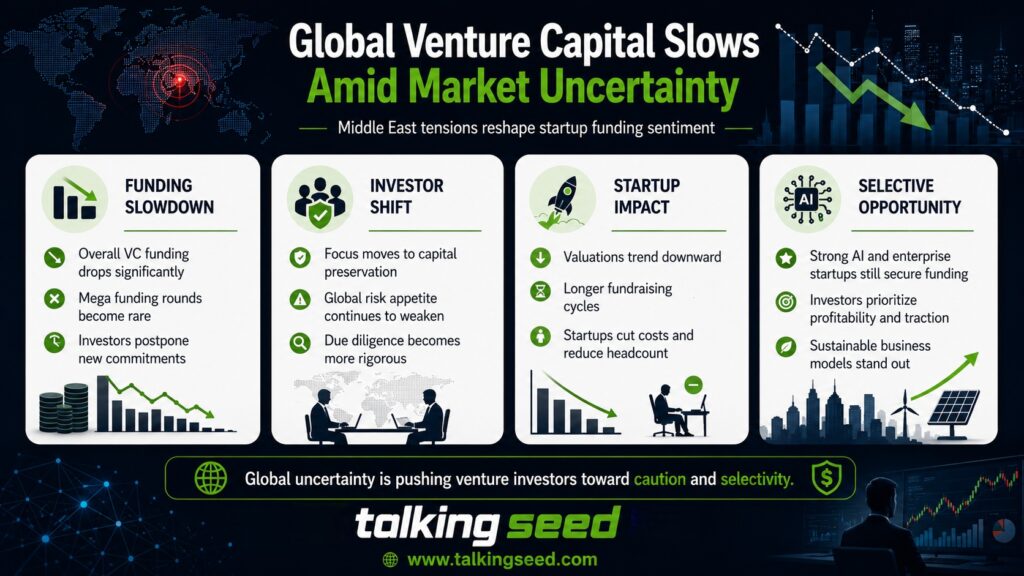
The increase in geopolitical risk venture capital concerns has forced many investors to slow down capital deployment. Venture firms that aggressively funded startups during the AI investment boom of 2024 and 2025 are now reassessing portfolios and preparing for longer exit timelines.
The Middle East war has added a new layer of uncertainty to an already fragile investment climate. Rising military tensions have affected oil supply routes, disrupted trade confidence, and increased fears of a wider regional conflict. These risks are directly influencing investor psychology.
“Markets dislike uncertainty more than anything else,” said one global investment strategist. “When geopolitical tensions rise, venture capital firms become conservative because startup investments are inherently risky and long-term.”
Startups Face Funding Delays and Lower Valuations
The slowdown is becoming particularly painful for early-stage startups seeking Series A and Series B funding. Many founders are now reporting longer fundraising cycles, reduced investor interest, and tougher due diligence requirements.
In previous years, startups with strong growth projections could secure funding relatively quickly. However, investors in 2026 are prioritizing revenue stability, profitability, and operational efficiency over aggressive expansion.
Several technology startups have reportedly accepted “down rounds,” where companies raise capital at lower valuations than their previous funding rounds. This trend reflects weakening investor confidence and a growing belief that startup valuations became inflated during the AI and digital investment surge.
The venture capital slowdown 2026 has also forced many startups to cut costs aggressively. Layoffs are increasing in technology hubs worldwide as companies attempt to preserve cash reserves and extend financial runway.
Founders who once focused heavily on scaling are now concentrating on survival.
Geopolitical Risk Reshapes Investor Behavior
The relationship between global conflict and investment behavior has become increasingly evident in recent years. The current Middle East crisis is amplifying fears surrounding global economic stability, energy security, inflation, and supply chain reliability.
Geopolitical risk venture capital discussions now dominate investment meetings. Investors are closely monitoring whether the conflict could spread into neighboring regions or trigger broader economic consequences.
Historically, periods of geopolitical instability have caused venture capital activity to decline because startup investing relies heavily on long-term confidence. Venture firms prefer stable economic environments where public markets remain healthy and acquisition activity is strong.
However, uncertainty in 2026 has weakened both conditions.
Initial public offerings remain limited, acquisition deals are slowing, and global financial markets continue to experience sharp volatility. Without clear exit opportunities, many venture capital firms are reducing exposure to speculative investments.
The impact is especially noticeable among crossover investors and hedge funds that entered the venture capital market during low-interest-rate years. Many of these firms are now retreating from startup investing entirely.
Artificial Intelligence Funding Remains Strong but Selective
Despite the broader slowdown, artificial intelligence continues to attract investor attention. However, funding patterns have become far more selective compared to previous years.
Large AI infrastructure companies and enterprise-focused AI startups are still receiving capital because investors believe automation and productivity technologies will remain critical in a slowing economy.
At the same time, smaller AI startups without clear monetization models are finding it increasingly difficult to raise funds. Investors are no longer funding ideas alone. Instead, they want measurable revenue growth, enterprise partnerships, and realistic profitability timelines.
This shift reflects a broader correction in global VC trends where hype-driven investing is gradually giving way to financial discipline.
Some analysts believe the current market environment could ultimately strengthen the startup ecosystem by eliminating weak business models and rewarding sustainable innovation.
Sovereign Wealth Funds Become More Cautious
Sovereign wealth funds from the Gulf region have played a major role in global venture capital over the last decade. Funds from Saudi Arabia, the United Arab Emirates, and Qatar have invested billions into technology startups, venture firms, and innovation funds worldwide.
However, the Middle East war is creating uncertainty even among these traditionally aggressive investors.
As governments redirect attention toward regional stability, defense readiness, and energy market management, investment priorities may shift temporarily away from high-risk venture capital activity.
Some sovereign wealth funds are reportedly reviewing overseas commitments and slowing participation in large international startup rounds until geopolitical tensions stabilize.
This development is particularly significant because Gulf capital became an important source of liquidity during the global startup funding slowdown after 2022.
Without strong sovereign participation, many late-stage startups could face additional financing pressure.
Europe and Asia Experience Investment Weakness
The venture capital slowdown 2026 is affecting nearly every major startup ecosystem globally.
In Europe, rising energy costs and economic stagnation are weighing heavily on investor confidence. Technology startups across Germany, France, and the United Kingdom are seeing reduced funding activity as investors prepare for slower economic growth.
Meanwhile, Asia is facing a complex investment landscape. Chinese technology investment remains under pressure due to regulatory concerns and weaker economic expansion, while Southeast Asian startups are struggling with declining foreign investment flows.
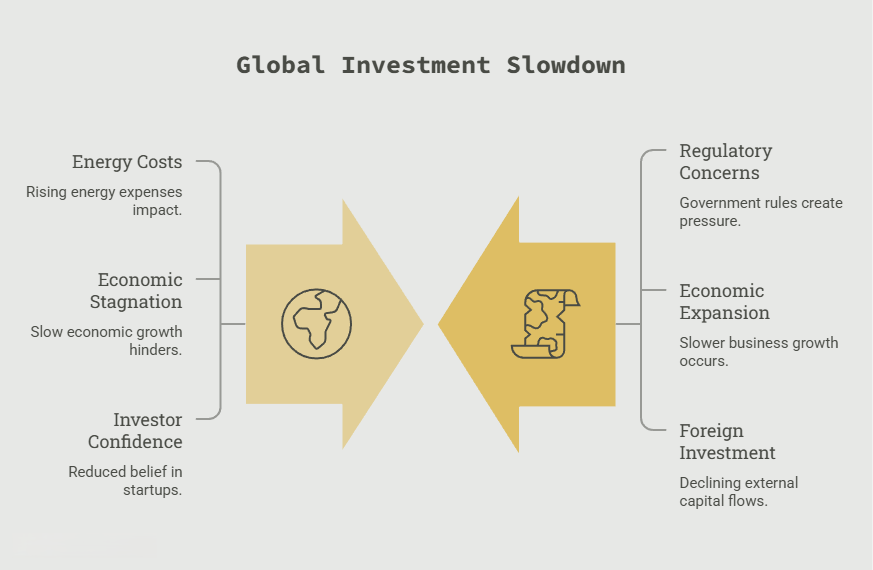
India, once considered one of the fastest-growing venture capital markets, is also experiencing slower deal activity. Investors are becoming more selective, focusing on startups with strong unit economics rather than rapid customer acquisition alone.
The combination of inflation, high interest rates, and geopolitical instability is creating a synchronized global investment slowdown rarely seen in recent years.
Startup Layoffs and Hiring Freezes Increase
One of the clearest signs of stress in the startup sector is the rise in layoffs and hiring freezes.
Technology companies that expanded aggressively during earlier funding booms are now cutting operational costs to preserve cash. Thousands of startup employees worldwide have already been affected in 2026 as companies reduce workforce expenses and delay expansion plans.
Recruitment activity in the startup ecosystem has weakened considerably. Many firms are pausing hiring entirely until funding conditions improve.
This shift is also affecting related industries such as digital marketing, software consulting, recruitment, and co-working spaces that depend heavily on startup growth.
Industry experts warn that prolonged funding weakness could slow innovation across multiple sectors if early-stage entrepreneurs struggle to access capital.
Interest Rates Continue to Pressure Venture Capital
In addition to war-related uncertainty, high global interest rates remain a major obstacle for venture capital markets.
When interest rates rise, safer investments such as government bonds become more attractive compared to risky startup investments. As a result, institutional investors often reduce allocations to venture capital funds during periods of monetary tightening.
Although some central banks have hinted at future rate cuts, persistent inflation driven partly by energy market instability has complicated those plans.
The Middle East conflict has pushed oil prices higher, increasing transportation and production costs globally. This inflationary pressure reduces the likelihood of aggressive interest rate reductions in the near term.
For venture capital firms, this means funding conditions may remain difficult longer than expected.
Mergers and Acquisitions Slow Down
The global VC trends for 2026 also reveal a decline in mergers and acquisitions involving startups.
Large technology companies are becoming more cautious about acquisitions due to economic uncertainty and shareholder pressure to improve profitability. This creates additional challenges for venture investors seeking exit opportunities.
Without strong acquisition markets or active IPO conditions, venture firms face delays in generating returns for limited partners.
This situation may eventually reduce fundraising activity for new venture capital funds, further tightening available startup capital.
Some investors now believe the venture capital market could remain subdued until geopolitical tensions ease and macroeconomic conditions stabilize.
Long-Term Impact on Innovation
While short-term challenges dominate headlines, many analysts believe the current downturn could reshape the future of global innovation.
Periods of financial discipline often produce stronger companies because founders are forced to focus on sustainable growth, operational efficiency, and real customer demand.
The startup environment of 2026 is becoming increasingly defined by resilience rather than rapid expansion.
Investors are rewarding businesses that solve practical problems, generate stable revenue, and demonstrate long-term viability. This may ultimately create a healthier startup ecosystem after years of excessive speculation and inflated valuations.
Still, the immediate outlook remains uncertain.
The ongoing Middle East conflict continues to create instability across energy markets, trade routes, and investor sentiment. Until geopolitical tensions ease, venture capital activity is expected to remain cautious.
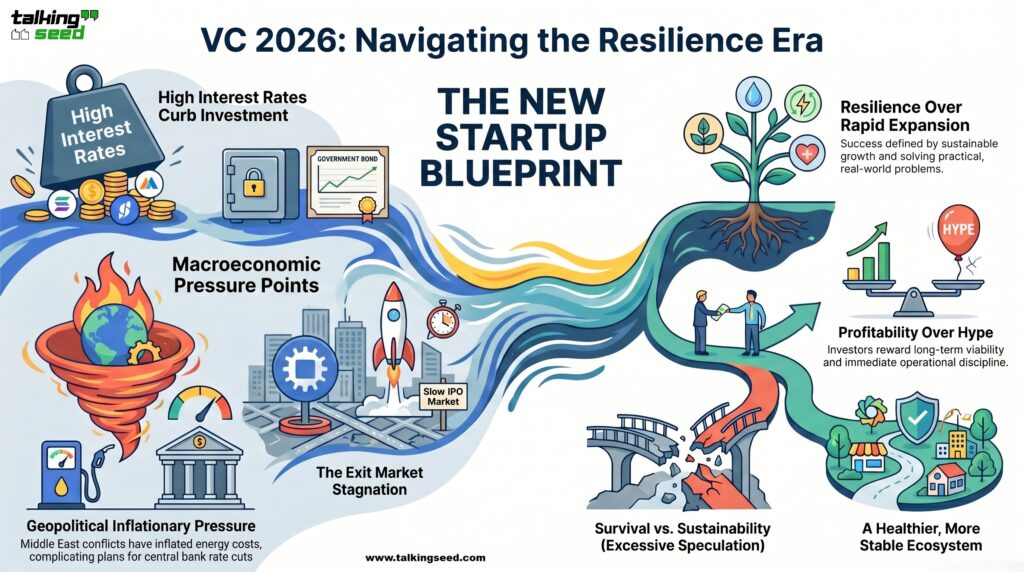
For entrepreneurs worldwide, the message from investors is becoming clear: profitability, discipline, and adaptability matter more than hype.
As the venture capital slowdown 2026 deepens, the global startup industry is entering a new era where survival and sustainability may become more valuable than rapid growth alone.